
Master Your Anger in 7 Steps
The full workbook to read. Practical exercises in seven steps: grab a pen and work through it at your own pace.
Prefer a nicely typeset PDF? We’ll email it to you.
Get the PDF by email →A practical workbook from AngerApp, built on the book The Anger Signal
By Dr. Johannes Hangl
Anger is a smoke alarm. It goes off when something you care about is under threat, and its whole job is to get you looking for the fire. This workbook shows you how to hear the alarm early, how to ride out the surge without doing damage, and how to say what the alarm was pointing at.
The seven steps follow the six parts of the book The Anger Signal, with the fourth part split in two. Each step gives you the core idea in plain words, one picture, one tool and one exercise. Keep a pen nearby, because the tools start to stick once you have written them down for your own life.
Every claim here comes from the book, and the book takes it from published research. The studies are listed at the back, and small numbers like [4] point to them along the way.
⚠️ Please read this first. This workbook is educational and is not therapy, medical advice, or a substitute for professional care. If your anger involves violence, threats, or abuse toward yourself or anyone else, or if you ever feel you might act on it, please reach out to a qualified professional. If you're in crisis or thinking about harming yourself or someone else, contact your local emergency number now: in the US call or text 988, in the UK call 111 or Samaritans on 116 123, elsewhere in Europe call 112. Reaching for help is a strength, not a failure.
How to use this workbook
There are seven steps, and each one builds on the step before it:
- Understand the alarm: what anger is for, and why it seems to go from zero to a hundred
- Read the signal early: the load under the trigger, the body's first warning, and the story you tell yourself
- Survive the surge: the ninety-second wave and the breath that brakes it
- Say it cleanly: turn blame into a sentence the other person can answer
- When it's aimed at you: stay steady while someone else is angry
- The home front: fights with the people you live with
- Make it last: repair, and a practice small enough to survive a bad week
You don't have to do all seven today. Start with Steps 1 and 3, because the first shows you how high your anger has climbed and the other gives you something to do once the heat is rising.
The ninety-second idea. The brain scientist Jill Bolte Taylor describes the chemical surge of an emotion such as anger as clearing out of your body in about ninety seconds, as long as nothing renews it [1]. The number comes from her own observation rather than from a controlled trial, and on a bad day your wave may run longer. What the stress research does agree on is the shape: an unfed surge clears in minutes, while a refuelled one lasts as long as you keep pouring fuel on it. The fuel is usually the story you keep telling yourself about what happened. Step 3 is about getting through the wave without feeding it.
🎧 Watch & listen
This workbook is the short version of AngerApp's full course: six parts, 32 lessons, 20 of them with video and audio. Watch and listen for free, and use the video for each step where there is one:
- Full course on YouTube: English playlist · Deutsche Playlist
- Companion podcast on Spotify: English · Deutsch
| This step | Watch (English) |
|---|---|
| Step 1 · Understand the alarm | L1: What is anger? |
| Step 3 · Survive the surge | L5: Breathing to calm the storm |
| Step 3 · Survive the surge | L8: Meditation for anger (RAIN) |
| Step 4 · Say it cleanly | L10: NVC foundations |
| Step 4 · Say it cleanly | L11: Working with your anger through NVC |
| Step 5 · When it's aimed at you | L14: Tactical Empathy |
| Step 7 · Make it last | L18: The 30-minute anger reset protocol |
Steps 2 and 6 have no lesson video of their own. The book covers them in Chapters 6–9 and 21–26. The full course, all lessons in English and German, is at angerapp.io.
Step 1: Understand the alarm
Most people believe the anger itself is the problem, and that a calmer, better person would not feel it at all. The research in the first part of The Anger Signal says something stranger. The two popular cures, venting it and swallowing it, both make things worse. The raw signal, meanwhile, turns out to be one of the most useful things your brain does.
Think of anger as a smoke alarm. It is loud and hard to ignore on purpose, and it carries one message: something, somewhere, is burning. It cannot tell a house fire from burnt toast, and it doesn't need to, because its only task is to get you looking. The exploder lets the siren blast through the house at every wisp of smoke, until everyone stops listening. The suppressor pulls the battery, and the house stays quiet right up to the day the smoke is real. There is a third way: keep the alarm, calibrate it, and learn to read it.
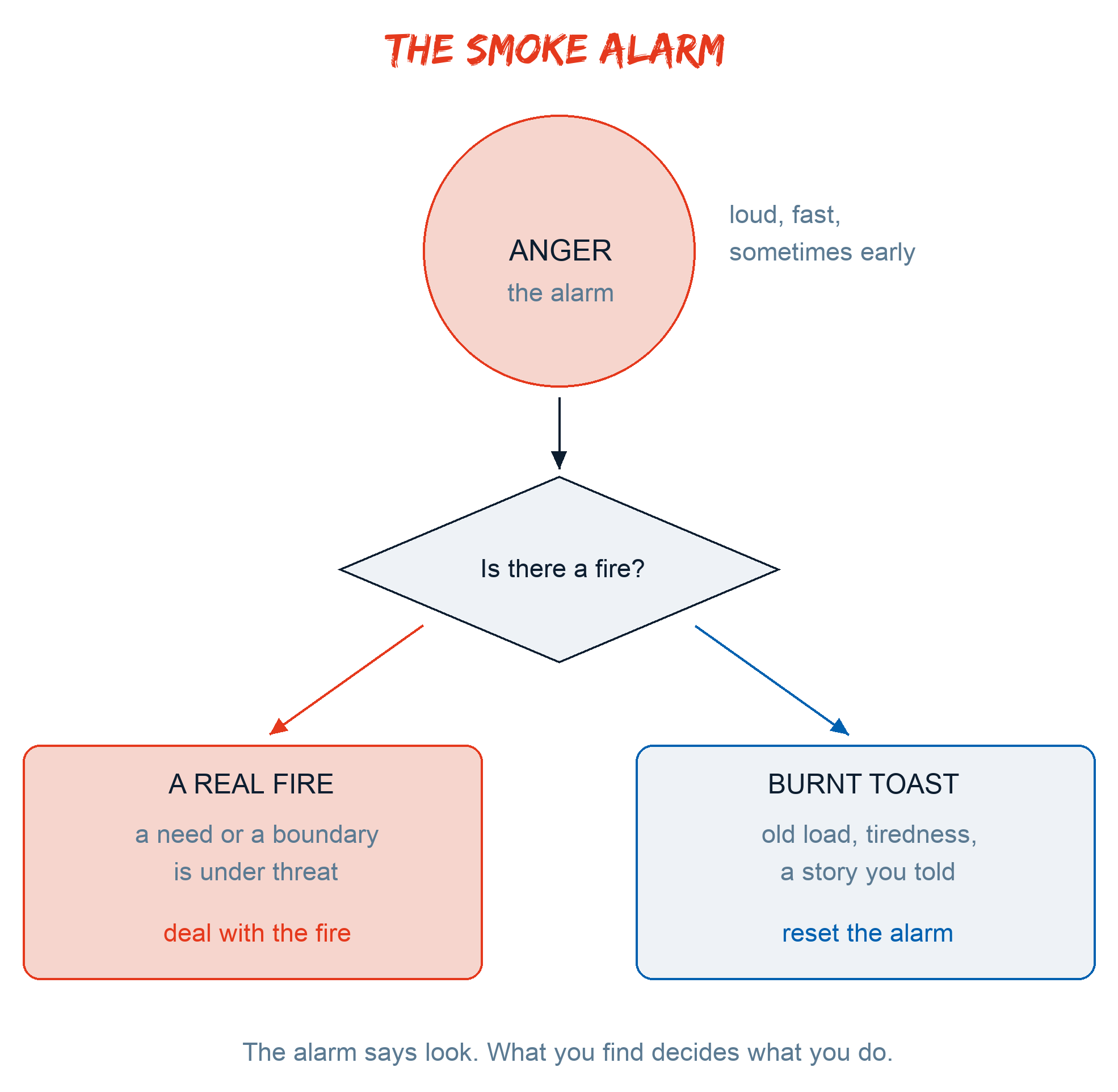
🔬 The evidence. In 2002, Brad Bushman made students angry with an insulting comment on their essays and then handed some of them a punching bag. The ones told to think about their critic while hitting it came out the angriest and the most aggressive, and the group that sat quietly for two minutes did best of all [2]. Swallowing anger fails too, only more quietly. When James Gross asked people to keep a neutral face during a disturbing film, their faces stayed calm while their sympathetic nervous system ramped up underneath [3]. And when James Averill had ordinary people keep diaries of their real anger, most episodes turned out to be conversations rather than combat, and a majority were rated as more helpful than harmful [4].
When your reaction is far bigger than the trigger, the size of the gap is the clue. Anger is often a secondary emotion, a bodyguard standing in front of something softer: hurt, fear, shame, and powerlessness [5]. That is the anger iceberg, with the loud part above the waterline and most of the mass below it. The question that opens it up is short: if I weren't angry right now, what would I have to feel?
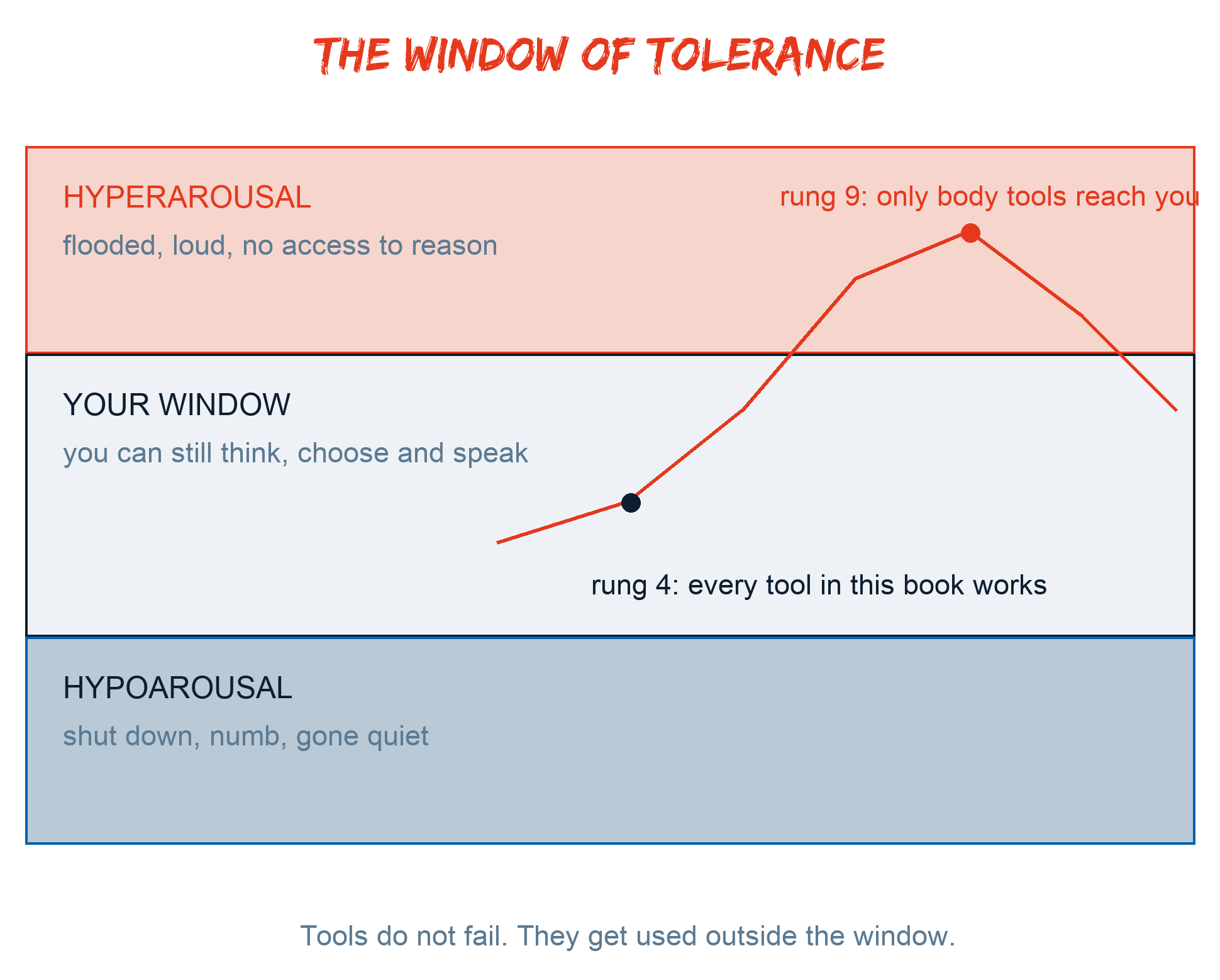
The other thing to know about the alarm is that it climbs. People say their anger goes from zero to a hundred, and almost always they just didn’t notice anything until it was loud. Chapter 4 of the book builds a ladder with four rungs: irritation, frustration, anger and rage. Your thinking brain is fully online at the bottom. By the top, the alarm has outvoted it, because the alarm fires faster than your judgment can wake up [6]. That is why every calming tool has a ceiling. The tools work on the low rungs and fail near the top, so the whole game is to catch the climb early.
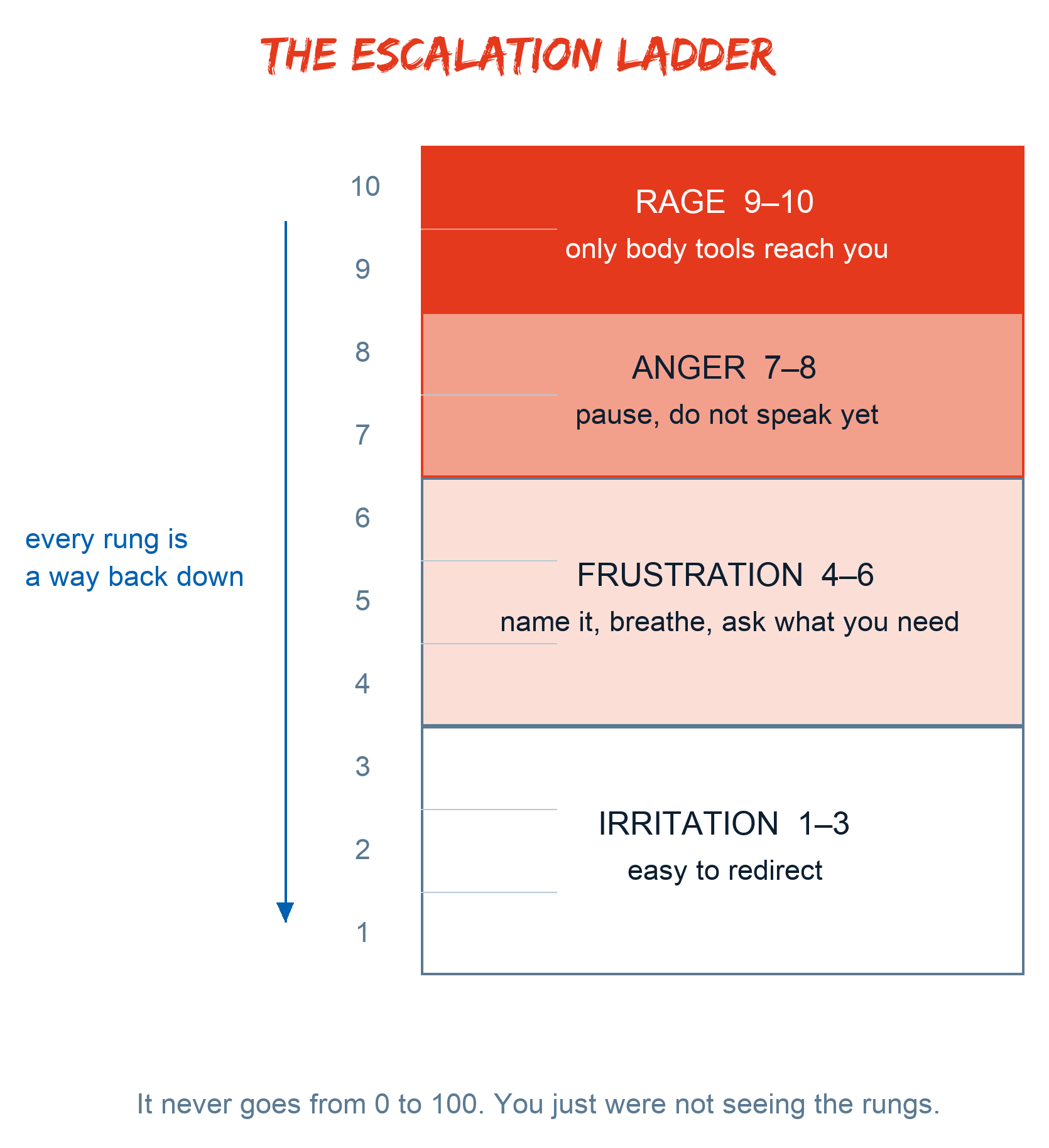
Naming where you are helps more than it sounds. Lisa Feldman Barrett's team found that people who can tell irritation from frustration from resentment regulate their feelings measurably better than people for whom it is all just "bad" [7]. I'm at a 4 and climbing is a reading you can act on, and I'm angry is a fog you can't.
🧰 Tool: Name the Rung
Takes four minutes to build and a few seconds to use.
- Draw your ladder. Write your own rungs from bottom to top, between three and seven of them, in your own words: "clipped", "prickly", "hot", "gone". Give each one a number from 0 to 10.
- Attach a body signal to each rung. Jaw, heat in the chest, a rising voice, tunnel vision: whatever reliably shows up at that height.
- Mark the tool line. Draw a line, usually around 6 or 7, above which calming tools stop working and the only move is to leave the room and let the charge out of your body. Know where it sits before you need it.
- Start an Anger Log. One note on your phone or one page in a notebook. Each entry gets four fields: what triggered it, how high it peaked, what you did, and how long it took until you felt calm. Add a fifth field for the number at which you first noticed it.
If you are the one who goes quiet rather than loud, give your ladder one extra level at the bottom: the one labelled fine, said through a tight jaw. Your climb is quieter, with resentment where other people have volume, but it is the same ladder.
✍️ Exercise 1: Your ladder and your last three flare-ups
Fill in your ladder from the bottom up, in your own words.
| Number | My word for it | What my body does here |
|---|---|---|
| 8–10 | ||
| 6–7 | ||
| 3–5 | ||
| 0–2 |
My tool line sits at: ______
Now log your last three flare-ups from memory. These are the first entries in your Anger Log.
| What triggered it | Peak (0–10) | What I did or said | How long until calm | First noticed at (0–10) |
|---|---|---|---|---|
Go deeper: The Anger Signal, Chapters 1–5.
Step 2: Read the signal early
The same small thing can bounce off you on a rested Saturday morning and blow up in your hands on a Thursday at seven. The trigger is the spark, the event right before the anger that everyone in the room can see. The cause is everything that had already made you flammable by the time the spark landed. A spark on wet wood does nothing, while the same spark on dry tinder takes the house. The world will never run out of sparks, so your lever is your own dryness.
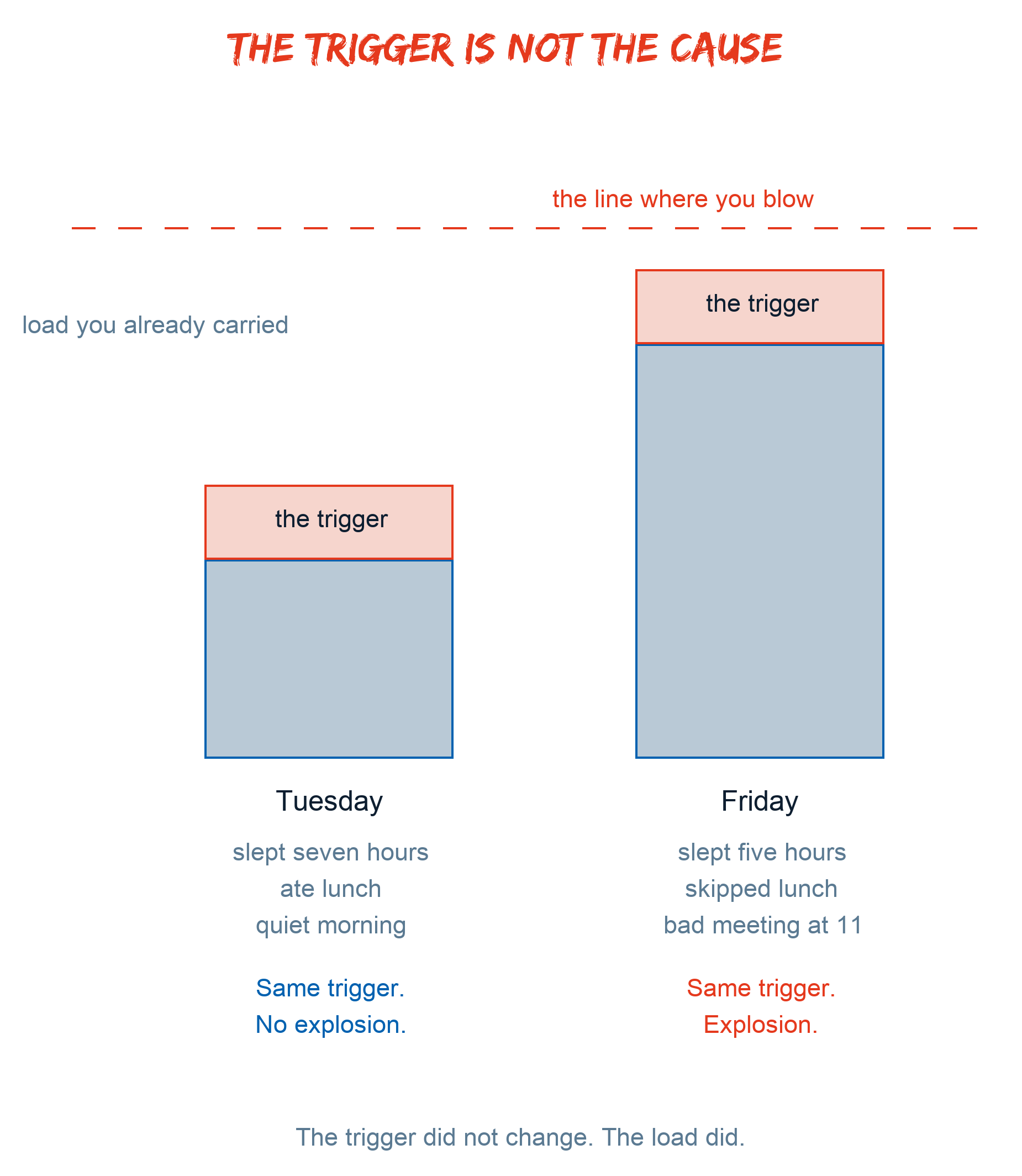
Recovery programmes have used the acronym HALT for decades: hungry, angry, lonely, tired. The "angry" means already stirred up, with charge left over from an earlier fight or a bad email, and the book adds a fifth letter for stressed. In each of these states the slow, thinking part of your brain runs on low power, so it loses the vote to the alarm faster and at smaller provocations. For a great many people, the anger intervention that works best is a sandwich, a glass of water and a decent night's sleep.
🔬 The evidence. Matthew Walker's team kept healthy volunteers awake for a night, let a matched group sleep, and then showed both groups unpleasant images in a brain scanner. In the sleep-deprived brains the amygdala fired roughly sixty percent harder, and its connection to the prefrontal cortex had gone slack [8]. One missed night had left the alarm louder and the thinking brain weaker.
Your body gives you a second early warning. Before the thought "I'm angry" arrives, your jaw has often tightened, your shoulders have climbed and your breath has gone short. Reading your body from the inside has a name, interoception, and it is a skill you can train. In a German study led by Jürgen Füstös, people who could count their own heartbeat accurately were measurably better at dialling a feeling down once it had started [9].
The psychiatrist Dan Siegel calls the zone in which you can still think and feel at the same time the window of tolerance [10]. Your tools work inside the window and fail above it. Its upper edge is the tool line on your ladder, met from the inside. Your body's early signs tell you that you are getting close to it while there is still room to act.
The last early signal sits between the event and the feeling. Something happens, you tell yourself a story about what it means, and only then do you feel the anger [11]. The usual story is hostile: they did it on purpose, and they did it against you. Researchers call this hostile attribution bias, and its tell is the phrase on purpose [12]. Chapter 8 puts that story on trial with the Courtroom Test, which is worth having on the evening a one-word text message ruins your mood.
🧰 Tool: The Trigger Map and the Load Check
Takes ten minutes once, then ten seconds a day.
- Find your three most common triggers. Use your Anger Log from Step 1. Be specific: "being ignored after the third request" is more useful than "my kids".
- Write the load next to each one. What was usually also true at the time? Tired, hungry, already stirred up?
- Spot the common load. For most people it is one or two repeat offenders, usually sleep and being already stirred up.
- Run HALT-S once a day. Hungry, angry already, lonely, tired, stressed: name which ones are lit.
- Defuse what you can and flag what you can't. Eat if you're hungry and lower the day's stakes if you're tired. On a dry-tinder day, give the people around you some extra grace.
✍️ Exercise 2: Map your triggers, then check your load for a week
| My trigger | The load usually underneath (H, A, L, T, S) |
|---|---|
Run the load check once a day for the next seven days, at the hour your dip usually comes. Tick what is lit, and write one thing you did about it.
| Day | H | A | L | T | S | What I did about it |
|---|---|---|---|---|---|---|
| 1 | ☐ | ☐ | ☐ | ☐ | ☐ | |
| 2 | ☐ | ☐ | ☐ | ☐ | ☐ | |
| 3 | ☐ | ☐ | ☐ | ☐ | ☐ | |
| 4 | ☐ | ☐ | ☐ | ☐ | ☐ | |
| 5 | ☐ | ☐ | ☐ | ☐ | ☐ | |
| 6 | ☐ | ☐ | ☐ | ☐ | ☐ | |
| 7 | ☐ | ☐ | ☐ | ☐ | ☐ |
Go deeper: The Anger Signal, Chapters 6–9.
Step 3: Survive the surge
Everything so far happens before the surge. This step is for the moment itself. The trigger has landed, the heat is climbing, and you are standing at a fork you have stood at a thousand times. The move is simple to describe and hard to do in the moment: you ride the wave without feeding it.
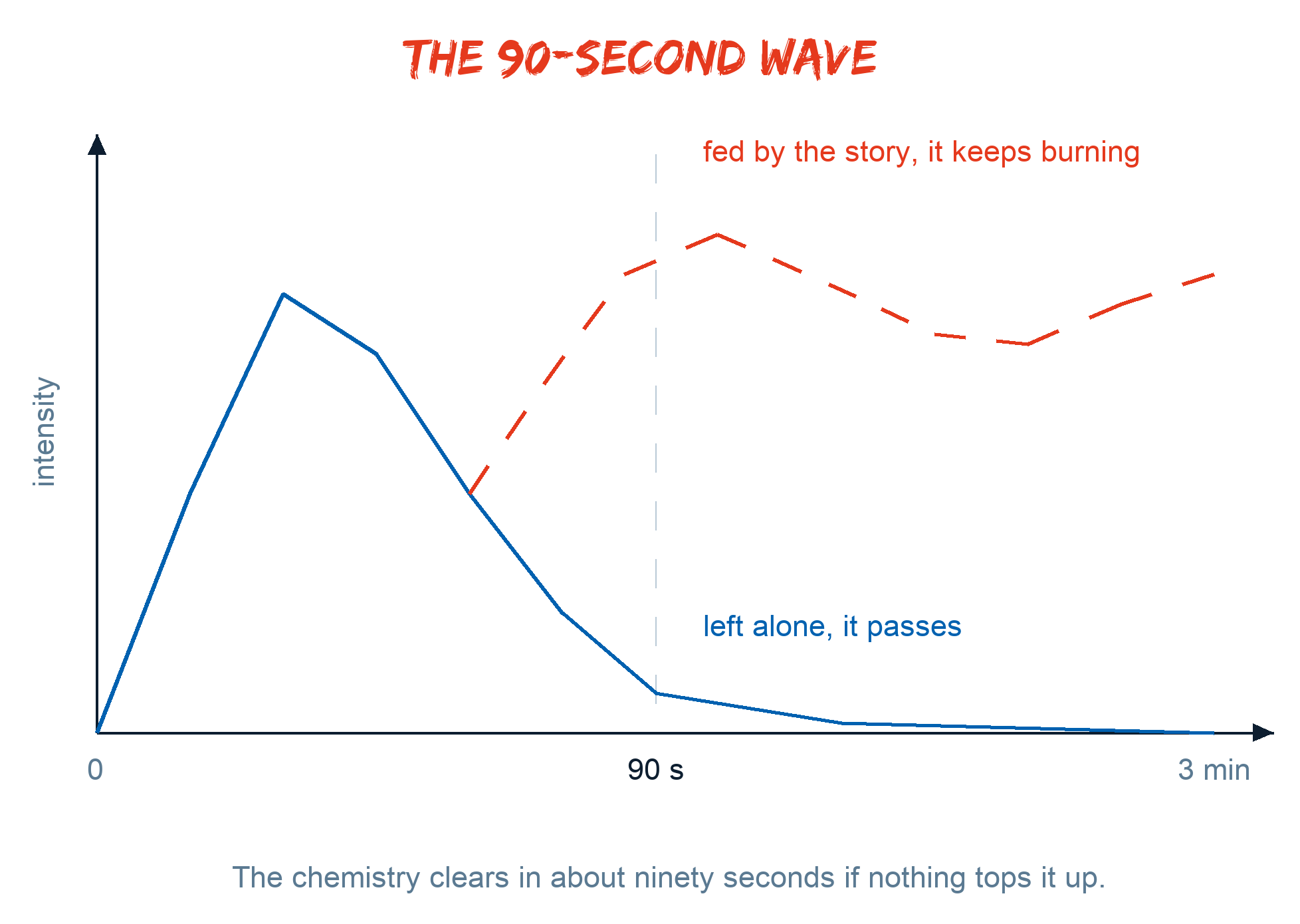
The ninety-second wave from the start of this workbook is worth planning around. It rises, crests and falls, and at the bottom you are still upset but no longer flooded. What restarts it is your attention. Each time you replay what they did, rehearse the comeback or check that the grievance is still there, you order a fresh surge. Susan Nolen-Hoeksema's research on rumination found exactly that: replaying a painful event keeps the anger going instead of releasing it [13]. Your only job in the moment is to stop feeding the wave for about ninety seconds, which is a far smaller task than making the anger go away.
Naming the feeling helps on the wave as well. Matthew Lieberman at UCLA found that simply putting a feeling into words turned down the amygdala's response [14]. A silent I'm angry, this is the wave buys you a little air.
Breath is the other lever. It is the one part of your automatic nervous system that you can also steer on purpose. When you breathe in, your heart speeds up slightly, and when you breathe out, the vagus nerve slows it down again [15]. The exhale is the brake. "Take a deep breath" fails so often because people hear deep and take a sharp inhale, which presses the accelerator. The useful version is three words long: long exhale, early.
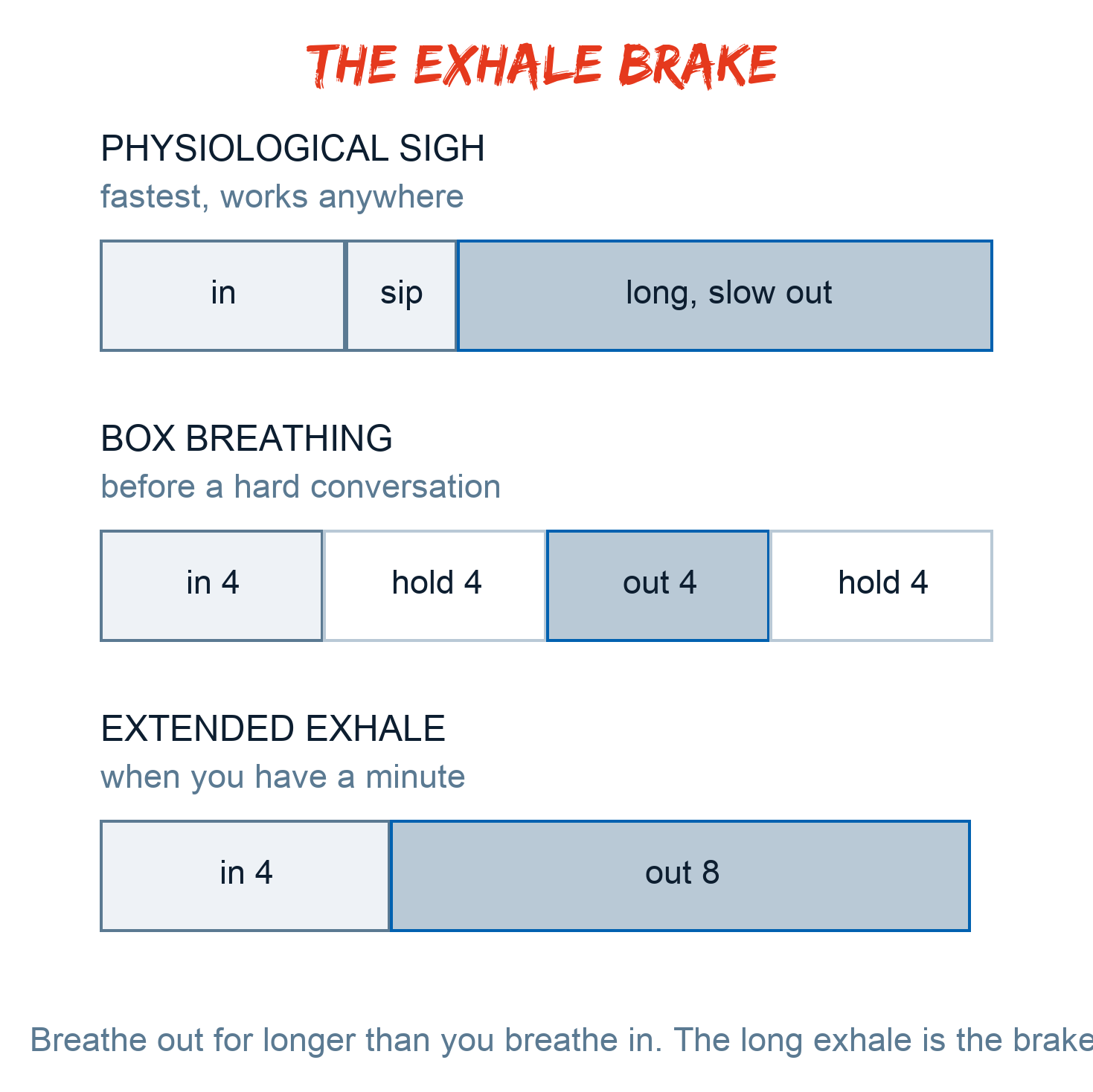
🔬 The evidence. A Stanford team led by Melis Balban and David Spiegel compared five minutes a day of cyclic sighing with five minutes of mindfulness meditation over a month. The sighing group came out ahead on mood and on resting breathing rate [16]. That trial tested a daily practice. Taking one to three sighs in the middle of a surge rests on the mechanism, which is solid, rather than on that study.
Breath has a ceiling, as every calming tool does. Used early, it works, and used above your tool line it barely reaches you. Up there the move is to leave the room with a named return and change your physical state directly. Cold water on your face or wrists slows the heart through the dive reflex; if you have a heart condition, ask your doctor first and stick to the wrists [17]. Big muscles let the charge out: push against a wall, sprint up the stairs, walk hard. Push, and never punch, because hitting something while you replay the grievance rehearses the rage, as Bushman's punching bag showed [2].
One warning belongs here. If focusing on your breath ever makes you dizzy, tingly or detached, stop. Move your attention to your senses instead, for example by naming five things you can see. Over-breathing can blow off too much carbon dioxide and produce something close to panic [18].
All of this works better when you have practised it while calm. The book's Daily Ten is ten minutes a day of noticing your mind wander and bringing it back. That is the same move you need when a story pulls at you mid-surge. In Richard Davidson's eight-week study of stressed office workers, mindfulness training shifted brain activity toward a pattern linked with lower reactivity [19]. The book is honest about the size of that effect for ordinary practice: real, and moderate.
🧰 Tool: The Hot-Moment Protocol with the Exhale Brake
Learn it while calm. It takes ninety seconds by design.
- Notice and name. At your first body sign, say silently: "I'm angry. This is the wave."
- Drop the story. Every replay restarts the clock. Tell yourself: "Not now. Right now I just ride."
- Brake with the exhale. Feet flat on the floor, then a physiological sigh: a full breath in through the nose, a short sip of air on top, and a long, slow breath out through the mouth. Do one to three.
- Count it down. Count slowly to ninety. The count gives the chemistry time to clear and keeps the mind too busy to ruminate.
- Reassess at the bottom. Still above your tool line? Leave the room and let the charge out. Back inside the window? Now you can decide what to say.
✍️ Exercise 3: Pair the brake to your first sign, and practise it cold
A breath only works in a hard moment if you have practised it in an easy one. Pair it to the first body sign you found in Step 2, so the tool fires early instead of too late.
When I notice ______________________ (my first body sign), I take three long exhales.
Over the next week, practise the physiological sigh or box breathing for two minutes a day while you are calm. Box breathing means in for four, hold for four, out for four, hold for four. Tick each day off.
| Day 1 | Day 2 | Day 3 | Day 4 | Day 5 | Day 6 | Day 7 |
|---|---|---|---|---|---|---|
| ☐ | ☐ | ☐ | ☐ | ☐ | ☐ | ☐ |
Go deeper: The Anger Signal, Chapters 10–13.
Step 4: Say it cleanly
Once the wave has passed, the anger still has something to say, and how you say it decides whether anyone hears it. Start an angry sentence with you, as in "you always" or "you never", and the other person's alarm fires. An attacked brain has exactly one priority, which is to defend. You can be completely right and it won't matter, because you have put the other person in a state where content can't reach them.
🔬 The evidence. In a brain-scanning study by Ethan Kross and colleagues, social rejection showed up in some of the same circuitry as physical pain [20]. So "that hurt" is closer to anatomy than to a figure of speech. And bad weighs more than good in the mind, by a wide and well-documented margin, which is why a hostile reading of your message sticks once it has formed [21].
Blame is the alarm thrown at someone. Underneath it is the signal, the fire you actually want them to see. "You're so inconsiderate" and "I feel unimportant, and I need to know I matter to you" come from the same feeling. The first makes the other person defend, and the second lets them see you.
Two details decide whether the signal lands. An observation is what a camera would record, while an evaluation is the verdict you attach to it: "three nights this week" is a fact, and "slob" is a charge they must defend against. And watch for faux feelings, which are verdicts dressed up as "I feel". "I feel disrespected" really means "you disrespected me", while hurt, scared, lonely and tired implicate no one [22].
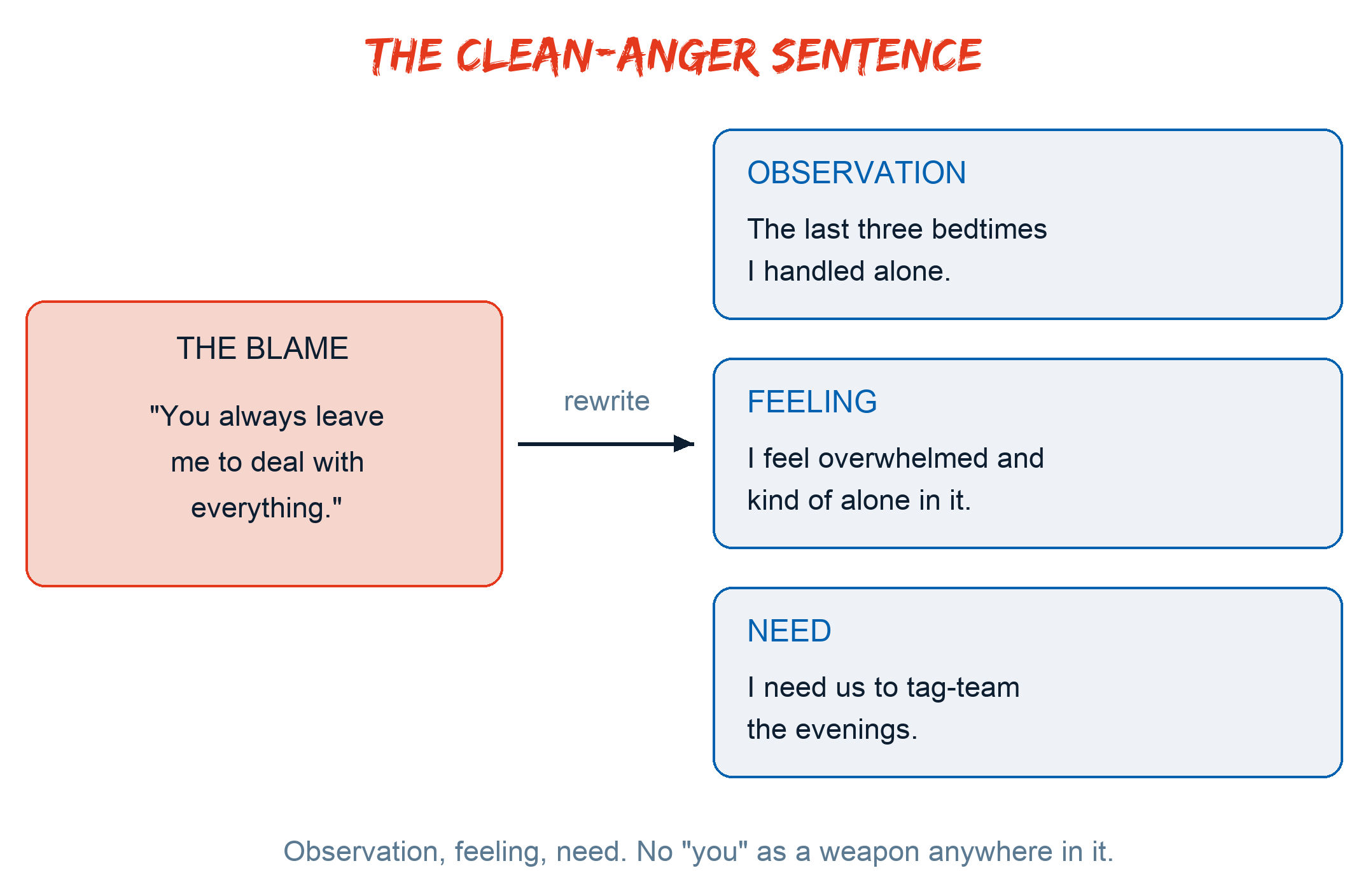
Sometimes you know something is wrong and can't say what would fix it. Marshall Rosenberg's Nonviolent Communication adds a fourth part for that, the request. Put roughly in his terms, anger is the tragic expression of an unmet need, because the blaming way we express it nearly guarantees that the need stays unmet [22]. A request and a demand can use identical words, and the difference shows when the answer is no. If you can hear "no" without punishing the other person for it, you made a request.
One rule for writing: a text message strips out your tone, so a tense reader supplies a hostile one. Leave the furious message in your drafts for 24 hours. When something matters and it has already gone sideways on a screen, send four words: Can we talk instead?
🧰 Tool: The Clean-Anger Sentence and the Need Finder
Takes five minutes. Start with a real situation.
- Write what your mouth wants to say. The blame, raw: "You always leave me to deal with everything."
- Find the camera fact. "The last three bedtimes, I did on my own."
- Find the real feeling. Run the faux-feeling test: "overwhelmed and alone" passes, and "abandoned" is a verdict.
- Find the need. If you're stuck, ask why does that matter to me? three times. Each answer drops you a level, down to a need any person would recognise: rest, respect, connection, to matter.
- Assemble the sentence and add a request. Observation, feeling, need, and one specific, doable ask. Then check yourself: am I ready to hear no?
✍️ Exercise 4: Build one clean sentence
Pick a real conversation you have been avoiding and build it line by line.
| Part | My version |
|---|---|
| What my mouth wants to say | |
| The camera fact | |
| What I actually feel | |
| What I need | |
| My request ("Would you be willing to…?") |
Read it aloud. Would you say it to someone you respect? Adjust it until you would.
Then turn each of these into a camera fact:
| The blame | The camera fact |
|---|---|
| "You never help around here." | |
| "You embarrassed me in front of everyone." |
Go deeper: The Anger Signal, Chapters 14–15.
Step 5: When it's aimed at you
Steps 3 and 4 are for your own anger. This step is for the evening when someone else's anger is aimed at you. The reframe that helps most is that their anger is a smoke alarm too. Under the shouting there is usually fear, hurt or powerlessness, a need of theirs going unmet. That does not make the way they express it okay, and you can still set a limit. Once you can hear the need under the attack, though, you stop taking the surface personally, and your own alarm quiets enough for you to stay steady.
The first move is always yours: regulate yourself, because you cannot be anyone's calm while you are flooded. Listen to understand, and let go of the rebuttal you are loading. If the criticism is unfair, find the part that is true, perhaps ten percent of it, and say that part out loud. Agreeing with the true ten percent takes the wind out of the rest. If there is a line, such as shouting or insults, name it calmly and hold it: "I want to hear you, and I won't be shouted at."
Chris Voss, who negotiated with hostage-takers for the FBI, calls the core skill tactical empathy: showing out loud, and accurately, that you understand the other person's world [23]. Agreeing with them is optional. Making them feel seen is the point, because someone at the top of the ladder needs that more than any argument. The main move is a label, said tentatively: "It seems like you're really frustrated." "It sounds like this feels unfair to you." Name the feeling rather than the facts, and leave a pause so they can correct you.
🔬 The evidence. Labelling someone else's feeling very likely works on the same principle as naming your own. Lieberman's scanner study found that putting a feeling into words turned down the amygdala's response [14]. A person high up the ladder has lost the part of the brain that finds those words, so you supply them from outside.
A few more moves carry the rest. Drop into what Voss calls the late-night FM DJ voice: low, slow and calm, with your sentences falling at the end. Emotional states spread from person to person, and a calm voice spreads as readily as an alarmed one [24]. A sharp voice undoes even a perfect label. Before a hard conversation, run an accusation audit, which means saying their worst thoughts about you first, calmly: "You might be thinking I don't care about this at all." What you are hoping to hear back is "That's right." It means they feel understood, and it is worth far more than "you're right", which people often say to end a conversation they have given up on.
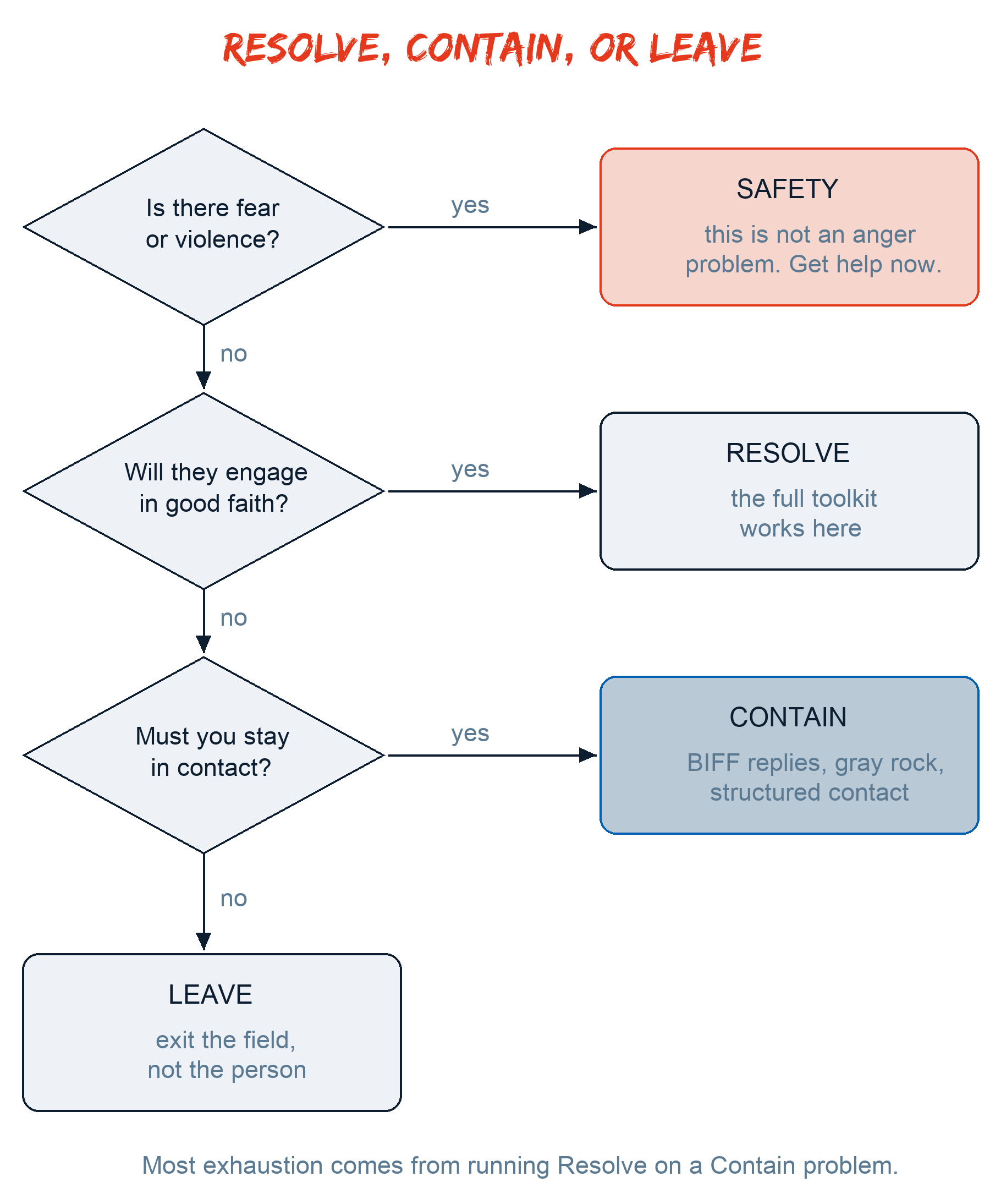
Some conflicts can't be fixed with any of this. Bill Eddy, a lawyer and mediator, describes high-conflict people by four features that travel together [25]:
- a target of blame, which is never them;
- all-or-nothing thinking;
- emotions far out of proportion, with no embarrassment afterwards;
- behaviour that goes further than a regulated person would go.
With that pattern, empathy and reasoning often backfire. So sort every hard, ongoing conflict into one of three kinds. Resolve it when the person is basically reasonable, and use everything above. Contain it when they are high-conflict and you can't leave, with replies that are brief, informative, friendly and firm, and as little contact as the situation allows. Leave it when the relationship is doing you harm and can be ended. One line overrides all of this. If there is fear or violence in your home, you have a safety problem, and the box at the top of this workbook applies today.
🧰 Tool: The De-escalation Set
Takes ten minutes to rehearse and seconds to use. Practise the voice first, because it carries the rest.
- Drop into the DJ voice. Slow down, lower your pitch, and let your sentences fall at the end.
- Lead with an accusation audit. Say their worst thoughts about you before they can.
- Label instead of arguing. "It seems like you're really hurt." Then stop, and let them correct or confirm it.
- Label the ugly feelings directly. "It seems like you're furious with me right now."
- Aim for "that's right." Keep labelling until you hear it.
✍️ Exercise 5: Prepare for one person
Think of someone whose anger you regularly face. What are they usually feeling underneath? Draft three labels:
- It seems like ______________________________
- It sounds like ______________________________
- It looks like ______________________________
List the worst things they might be thinking about you, so you can say them first:
Now sort the conflict honestly, and write the one limit you will hold this week.
This conflict is one I can: resolve / contain / leave The limit I will hold, and how: ______________________________
Go deeper: The Anger Signal, Chapters 16–20.
Step 6: The home front
Anger at home has its own rules, because the people involved can't simply walk away from each other. The book's part on the home front opens with a small rule for the request you have already made three times. Decide on a calm evening what happens at request three, so the fourth one never arrives. The rest of this step is about the fight that has already started.
John Gottman wired couples to heart-rate monitors while they argued. His rule of thumb is that once your heart rate climbs past roughly 100 beats a minute, fair fighting is over for the time being [26]. He calls it flooding, and it is what Step 2 called leaving the window of tolerance. Up there you can't take in new information or reach for empathy, so "talk it out, however long it takes" lets two offline brains say things neither of them can take back. The body also settles more slowly than it feels. You feel calm before you are calm, which is why a fight you thought was over flares up again three minutes later. Gottman's advice is to give a flooded body at least twenty minutes.
The answer is a structured pause with a named return: "I'm too flooded to do this well. Let's stop and pick it up after dinner." Without the return time, a pause reads as the silent treatment, and with it, the pause becomes a promise. Agree on a silly two-word truce signal in peacetime, so either of you can call the pause mid-fight without it landing as an insult. When you come back, open softly, with the clean sentence from Step 4. In Gottman's recordings, the way a conversation began tracked closely with how it ended. The book treats that as a strong pattern rather than a law, because the famous accuracy figures were fitted to couples the lab had already watched [27].
If you have children, one finding should take a weight off you. E. Mark Cummings had parents keep diaries of everyday disagreements at home and of how their children reacted [28]. The children reacted strongly to destructive conflict, the contempt and the slammed door, and barely reacted when their parents argued constructively and visibly worked it out. Children who see conflict followed by repair do as well as children who see no conflict at all. They also learn something extra: two people can be angry with each other and find their way back. So the aim is to fight cleaner in front of them and let them see the repair. One rule has no exceptions: a child is never the messenger, the ally or the referee.
🧰 Tool: The Trapped-Fight Protocol
Build the peacetime parts this week, and use the rest when you are locked in.
- Agree on a truce signal. A two-word code, ideally a silly one, that either of you can say to call an immediate pause.
- Agree on the twenty minutes. A called pause lasts at least that long, and "I feel fine now" after three minutes doesn't count.
- Call the pause with a named return. "I'm flooding. Let's pick this up at nine."
- Calm down side by side if you can't leave. In the car or a shared room, stop talking and let each of you regulate alone.
- Protect the driver. In a car, the person at the wheel calms down first, or you pull over.
- Re-enter softly. "I've settled, and I still want to work this out. Can we?"
✍️ Exercise 6: Your peacetime agreements
Sit down together on a calm evening and fill this in. If your co-parent or partner won't sign up, fill in your own half anyway, because most of these only need one adult to hold them.
| Agreement | Ours |
|---|---|
| Our truce signal | |
| How long a pause lasts | |
| The sentence that names our return time | |
| How we restart afterwards | |
| Our tag-out signal ("I'm at an 8, take over") | |
| What happens at the third request | |
| What the children never carry for us | messages, sides, verdicts |
Go deeper: The Anger Signal, Chapters 21–26.
Step 7: Make it last
You will lose it again. Good parents lose it, and so do good partners; what separates the strong relationships is what happens afterwards. Gottman found that even partners in great marriages misread and hurt each other constantly, and that the strong couples repair quickly and often [26]. Ed Tronick's still-face research found the same between mothers and babies. Even attentive mothers are in sync with their infants only a fraction of the time, and the endless small repairs are what the bond is made of [29]. Rupture is inevitable, and repair is the part you control.
A real apology has no "but" in it, because "I'm sorry I yelled, but you weren't listening" deletes everything before the comma. Name what you did, acknowledge the impact, and say briefly what you'll do differently. The part almost everyone skips is repairing yourself. Shame feels like accountability, yet June Tangney's research found that shame-prone people get defensive and report more anger, while guilt-prone people repair [30]. Kristin Neff's work on self-compassion points the same way: treating yourself with the steadiness you would offer a friend leaves you able to do better next time [31].
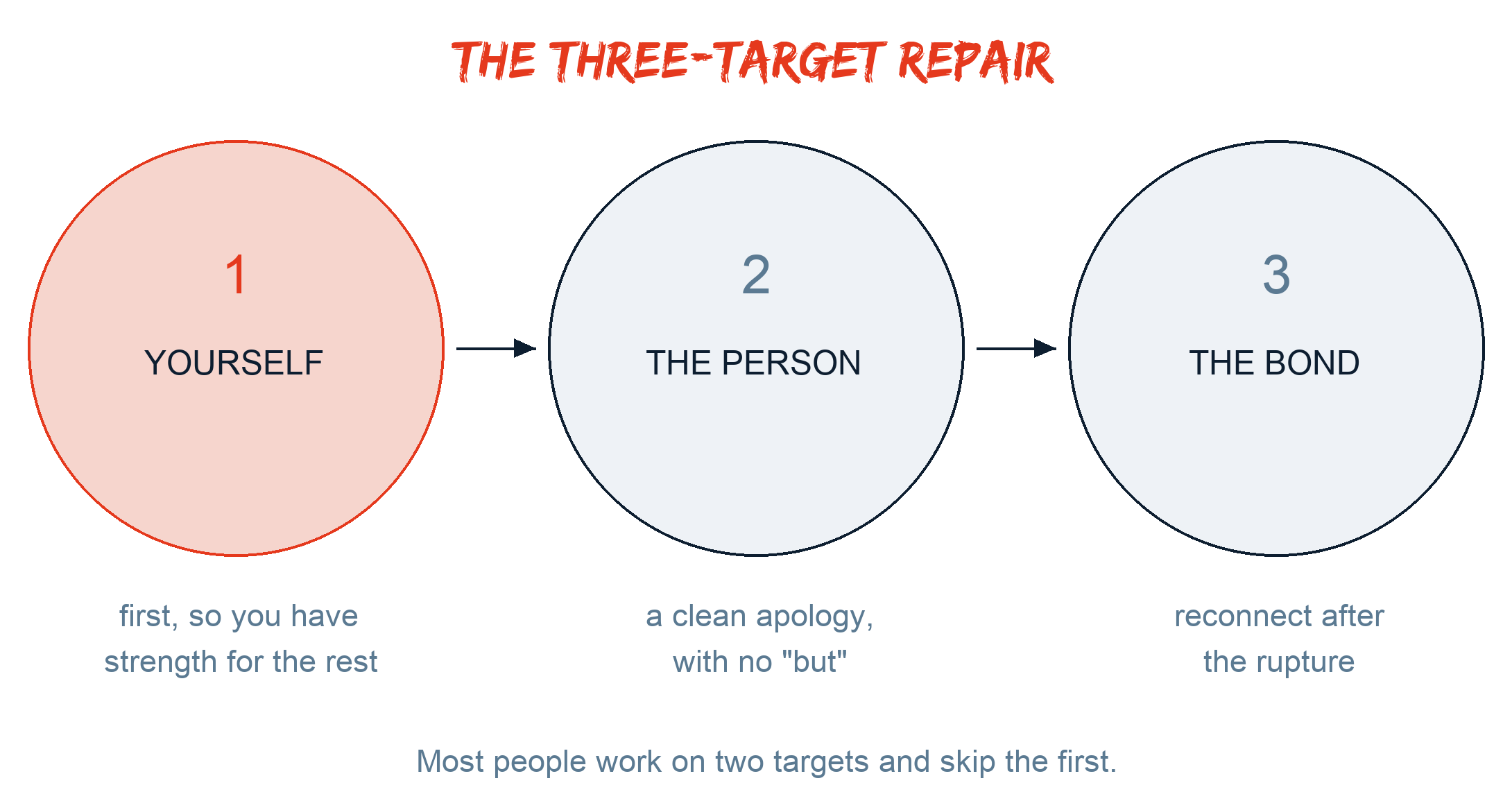
Making it last is a design problem. Motivation comes in waves and bottoms out on exactly the hard days when your anger is most dangerous. BJ Fogg, who studies how behaviour changes, found that a behaviour happens when motivation, ability and a prompt come together [32]. So you make the habit tiny and attach it to something you already do. Three exhales every time your jaw tightens, done a thousand times, will rewire more than a heroic routine you drop after two weeks. When you have a bad week, treat it as data about what loaded the gun, since progress in this work is a jagged line that trends down. The book's last chapter leaves you with one question to carry: who do you want to be in your worst moment?
🧰 Tool: The Three-Target Repair
Do it the same day if you can, once you are both out of the flood.
- Repair yourself first, briefly. "I did a harmful thing. That's guilt, and guilt is fair. Beating myself up will only make me more likely to do it again."
- Repair the person. Name what you did, specifically: "I yelled at you, and I frightened you."
- Own it with no "but". "That wasn't okay, and none of it was your fault."
- Say the one thing you'll do differently. Keep it brief, and promise effort rather than perfection.
- Repair the relationship. Do the ordinary thing that brings the warmth back: the hug, the shared task, the return to normal.
- Log it. Write the repair into your Anger Log next to the rupture.
✍️ Exercise 7: Your protocol and your 30-day plan
Choose three tools from this workbook, the ones that fit you: one for early warning, one for the moment itself, and one for saying it afterwards. If choosing feels like too much tonight, take the book's default set:
- the HALT-S check every day at your worst hour;
- the Hot-Moment Protocol for surges;
- the clean sentence once the wave has passed;
- a Three-Target Repair after every blowup.
Shrink each tool until it is almost impossible to fail, and attach it to something you already do.
| My tool | The tiny version | My anchor ("After I…") |
|---|---|---|
In my worst moment, I want to be the kind of person who ______________________________.
Add one tool a week rather than all of them at once, and keep logging every episode in one line.
| Week | What I add | Done |
|---|---|---|
| 1 | My early-warning habit, and nothing else | ☐ |
| 2 | My in-the-moment tool | ☐ |
| 3 | My tool for saying it afterwards | ☐ |
| 4 | The Three-Target Repair after every blowup | ☐ |
Go deeper: The Anger Signal, Chapters 27–31.
What you have now
You now have one tool from each part of the book. There is a ladder to read and a load check, a ninety-second protocol with a breath to brake it, and a clean sentence. There are labels for someone else's anger, a truce signal and a repair. The aim throughout is accurate anger, meaning the right amount, at the right thing, said in a way that gets the need underneath it met. Your alarm will keep going off, because that is its job, and with these tools you can hear it earlier and answer it better.
The book behind this workbook
The Anger Signal: Why you explode, what your anger is trying to tell you, and how to answer it by Dr. Johannes Hangl.
This workbook takes one tool from each part of the book, and the book has a tool in nearly every chapter. Each chapter opens with a real scene and explains the science behind it, with the studies named. Then it gives you a timed tool and tells you what to expect when you use it. Among the chapters this workbook only touches:
- why the alarm fires before your judgment can, and why "hijack" overstates it (Chapter 2);
- where your anger scripts come from, and the emotional funnel that turns sadness, fear and shame into anger (Chapter 3);
- what a social-media feed does to the ninety-second wave (Chapter 9);
- your default style in conflict, and how to change one move in the loop (Chapter 16);
- mirroring, calibrated questions and the strange power of letting people say no (Chapter 19);
- family days that blow up the plan, and the 80 percent rule (Chapter 26);
- letting go of an old grudge (Chapter 29);
- when anger points to something a doctor should look at, such as depression, ADHD or perimenopause (Chapter 30).
The back of the book holds a vocabulary of feelings and needs, the whole toolkit on two pages, and an Emergency Page for the worst moments.
Keep going
- 📚 Take the full course: six parts, 32 lessons, in English and German at angerapp.io
- ✉️ Join the newsletter: one practical anger-management idea in your inbox, no noise. Sign up at angerapp.io
- ▶️ Watch & listen free: YouTube · Spotify
AngerApp · Master your anger. One signal at a time.
The science behind this workbook
Every tool here rests on research that The Anger Signal cites and explains. Here is where to read more.
- Taylor, J. B. (2008). My Stroke of Insight: A Brain Scientist's Personal Journey. New York: Viking.
- Bushman, B. J. (2002). Does venting anger feed or extinguish the flame? Catharsis, rumination, distraction, anger, and aggressive responding. Personality and Social Psychology Bulletin, 28(6), 724–731.
- Gross, J. J., & Levenson, R. W. (1997). Hiding feelings: The acute effects of inhibiting negative and positive emotion. Journal of Abnormal Psychology, 106(1), 95–103.
- Averill, J. R. (1983). Studies on anger and aggression: Implications for theories of emotion. American Psychologist, 38(11), 1145–1160.
- Greenberg, L. S. (2017). Emotion-Focused Therapy (rev. ed.). Washington, DC: American Psychological Association.
- LeDoux, J. E. (1996). The Emotional Brain: The Mysterious Underpinnings of Emotional Life. New York: Simon & Schuster.
- Barrett, L. F., Gross, J., Christensen, T. C., & Benvenuto, M. (2001). Knowing what you're feeling and knowing what to do about it: Mapping the relation between emotion differentiation and emotion regulation. Cognition & Emotion, 15(6), 713–724.
- Yoo, S. S., Gujar, N., Hu, P., Jolesz, F. A., & Walker, M. P. (2007). The human emotional brain without sleep, a prefrontal amygdala disconnect. Current Biology, 17(20), R877–R878.
- Füstös, J., Gramann, K., Herbert, B. M., & Pollatos, O. (2013). On the embodiment of emotion regulation: Interoceptive awareness facilitates reappraisal. Social Cognitive and Affective Neuroscience, 8(8), 911–917.
- Siegel, D. J. (1999). The Developing Mind: Toward a Neurobiology of Interpersonal Experience. New York: Guilford Press.
- Beck, A. T. (1999). Prisoners of Hate: The Cognitive Basis of Anger, Hostility, and Violence. New York: HarperCollins.
- Dodge, K. A. (2006). Translational science in action: Hostile attributional style and the development of aggressive behavior problems. Development and Psychopathology, 18(3), 791–814.
- Nolen-Hoeksema, S., Wisco, B. E., & Lyubomirsky, S. (2008). Rethinking rumination. Perspectives on Psychological Science, 3(5), 400–424.
- Lieberman, M. D., Eisenberger, N. I., Crockett, M. J., Tom, S. M., Pfeifer, J. H., & Way, B. M. (2007). Putting feelings into words: Affect labeling disrupts amygdala activity in response to affective stimuli. Psychological Science, 18(5), 421–428.
- Gerritsen, R. J. S., & Band, G. P. H. (2018). Breath of life: The respiratory vagal stimulation model of contemplative activity. Frontiers in Human Neuroscience, 12, 397.
- Balban, M. Y., Neri, E., Kogon, M. M., Weed, L., Nouriani, B., Jo, B., Holl, G., Zeitzer, J. M., Spiegel, D., & Huberman, A. D. (2023). Brief structured respiration practices enhance mood and reduce physiological arousal. Cell Reports Medicine, 4(1), 100895.
- Foster, G. E., & Sheel, A. W. (2005). The human diving response, its function, and its control. Scandinavian Journal of Medicine & Science in Sports, 15(1), 3–12.
- Meuret, A. E., Wilhelm, F. H., Ritz, T., & Roth, W. T. (2008). Feedback of end-tidal pCO2 as a therapeutic approach for panic disorder. Journal of Psychiatric Research, 42(7), 560–568.
- Davidson, R. J., Kabat-Zinn, J., Schumacher, J., et al. (2003). Alterations in brain and immune function produced by mindfulness meditation. Psychosomatic Medicine, 65(4), 564–570.
- Kross, E., Berman, M. G., Mischel, W., Smith, E. E., & Wager, T. D. (2011). Social rejection shares somatosensory representations with physical pain. Proceedings of the National Academy of Sciences, 108(15), 6270–6275.
- Baumeister, R. F., Bratslavsky, E., Finkenauer, C., & Vohs, K. D. (2001). Bad is stronger than good. Review of General Psychology, 5(4), 323–370.
- Rosenberg, M. B. (2015). Nonviolent Communication: A Language of Life (3rd ed.). Encinitas, CA: PuddleDancer Press.
- Voss, C., & Raz, T. (2016). Never Split the Difference: Negotiating as if Your Life Depended on It. New York: HarperBusiness.
- Goleman, D. (2006). Social Intelligence: The New Science of Human Relationships. New York: Bantam.
- Eddy, B. (2018). 5 Types of People Who Can Ruin Your Life: Identifying and Dealing with Narcissists, Sociopaths, and Other High-Conflict Personalities. New York: TarcherPerigee.
- Gottman, J. M., & Silver, N. (1999). The Seven Principles for Making Marriage Work. New York: Crown.
- Heyman, R. E., & Slep, A. M. S. (2001). The hazards of predicting divorce without crossvalidation. Journal of Marriage and Family, 63(2), 473–479.
- Cummings, E. M., Goeke-Morey, M. C., & Papp, L. M. (2003). Children's responses to everyday marital conflict tactics in the home. Child Development, 74(6), 1918–1929.
- Tronick, E. Z. (2007). The Neurobehavioral and Social-Emotional Development of Infants and Children. New York: W.W. Norton.
- Tangney, J. P., & Dearing, R. L. (2002). Shame and Guilt. New York: Guilford Press.
- Neff, K. D. (2011). Self-Compassion: The Proven Power of Being Kind to Yourself. New York: William Morrow.
- Fogg, B. J. (2019). Tiny Habits: The Small Changes That Change Everything. Boston: Houghton Mifflin Harcourt.
By Dr. Johannes Hangl · © 2026 AngerApp.io · All rights reserved. This workbook is for education and self-help, and is not a substitute for professional medical or psychological care.