
Die Werkzeuge kombinieren
Ein Werkzeugkasten, an den du unter Druck nicht herankommst, ist eine Liste guter Ideen. Diese Lektion macht daraus ein Protokoll, das du jedes Mal gleich durchläufst.
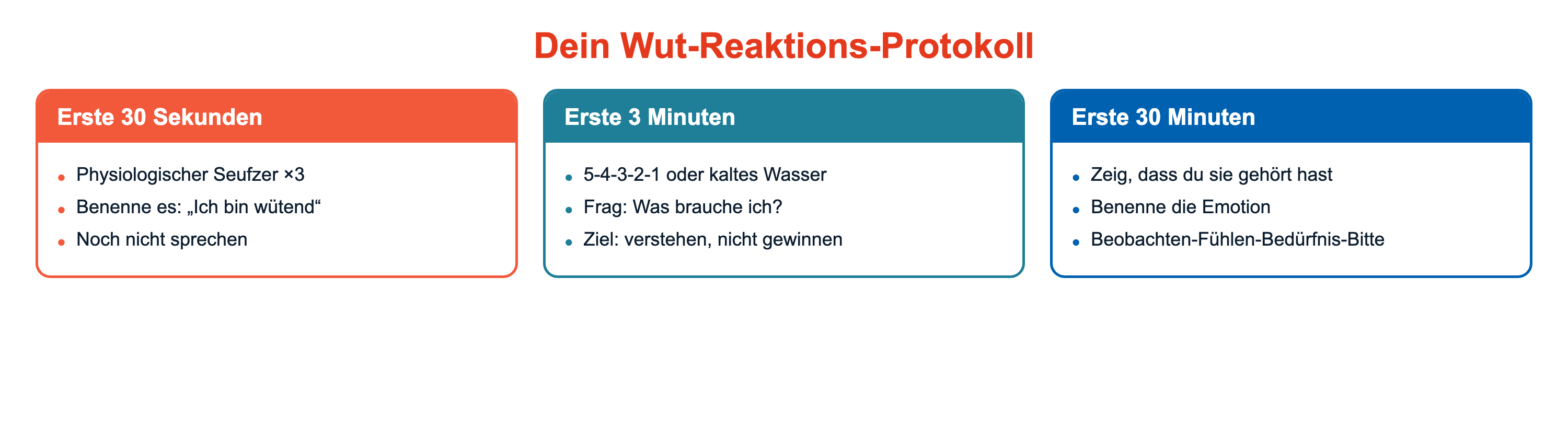
Die Werkzeuge wirken in verschiedenen Momenten, also sortiere sie nach der Uhr:
In den ersten 30 Sekunden, der Körper:\
- Benenne es stumm: „Ich bin wütend. Das ist die Welle.“\
- Nimm ein bis drei physiologische Seufzer: zweimal durch die Nase ein, einmal lang aus.\
- Sprich noch nicht, vor allem, wenn du über deiner Werkzeug-Linie auf der Leiter bist.
In den ersten 3 Minuten, stabilisieren:\
- Erde dich: Füße auf den Boden, 5-4-3-2-1 oder kaltes Wasser.\
- Lass die Welle auslaufen: Ungefüttert ist sie nach etwa neunzig Sekunden vorbei, und jedes Wiederabspielen der Geschichte startet sie neu.\
- Frag: Was brauche ich gerade?
In den ersten 30 Minuten, ins Gespräch gehen:\
- Hör zuerst zu, und benenne, was du beim anderen hörst.\
- Sag deine Seite als sauberen Satz: Beobachtung, Gefühl, Bedürfnis, Bitte.\
- Wenn einer von euch überflutet ist, pausiere mit benannter Rückkehr.
Danach flicken: eine Drei-Ziele-Reparatur nach jedem Ausbruch. Und jeden Tag eine Zeile in deinem Wut-Protokoll.
Zwei Anmerkungen zur Wissenschaft. Die neunzig Sekunden sind eine Beobachtung der Hirnforscherin Jill Bolte Taylor, keine Laborkonstante. Hinter dem physiologischen Seufzer steht eine Studie zur täglichen Übung von fünf Minuten, durchgeführt von einem Stanford-Team um Melis Balban und David Spiegel. Ihn mitten in der Welle einzusetzen stützt sich auf den Mechanismus, und der ist solide.
Wenn dir das Auswählen zu viel ist, nimm den Standardsatz aus dem Buch. Dazu gehören die HALT-S-Prüfung zu deiner schlimmsten Stunde und das Protokoll für den heißen Moment bei Wellen. Sobald die Welle vorbei ist, kommt der saubere Satz, nach jedem Ausbruch eine Drei-Ziele-Reparatur. HALT-S fragt, ob du hungrig, schon wütend, einsam, müde oder gestresst bist.
Im echten Leben: Lukas bekommt von seiner Schwester eine scharfe Nachricht wegen des Geburtstags ihrer Mutter. Er spürt, wie sich sein Kiefer anspannt, und benennt es: „Ich bin wütend. Das ist die Welle.“ Er atmet dreimal lang aus, legt das Handy mit dem Display nach unten und lässt die Welle vorbeiziehen, ohne die Nachricht im Kopf noch einmal abzuspielen. Darunter findet er Verletzung und das Bedürfnis, auf derselben Seite zu stehen. Zwanzig Minuten später ruft er an, statt zu schreiben: „Deine Nachricht hat mich getroffen. Ich will, dass wir dabei auf derselben Seite stehen. Können wir es zusammen planen?“
🎯 Kernbotschaft: Unter Druck folgst du entweder einem Plan oder dem Reflex. Schreib den Plan jetzt, solange du ruhig bist, damit er da ist, wenn du es nicht bist.
Probier es aus
Schreib dein eigenes Protokoll auf eine Karte. Wähle je ein Werkzeug für die ersten 30 Sekunden, die ersten 3 Minuten und die ersten 30 Minuten. Prüfe jedes an der Szene, die dir am häufigsten misslingt: Würde ein Werkzeug diese Szene nicht überleben, tausch es aus.
📱 In der App: Panik-Knopf
📖 Weiterlesen: Das Wut-Signal, Kapitel 10 und 31