
Combining the Tools
A toolkit you can't reach under pressure is a list of good ideas. This lesson turns it into one protocol you run the same way every time.
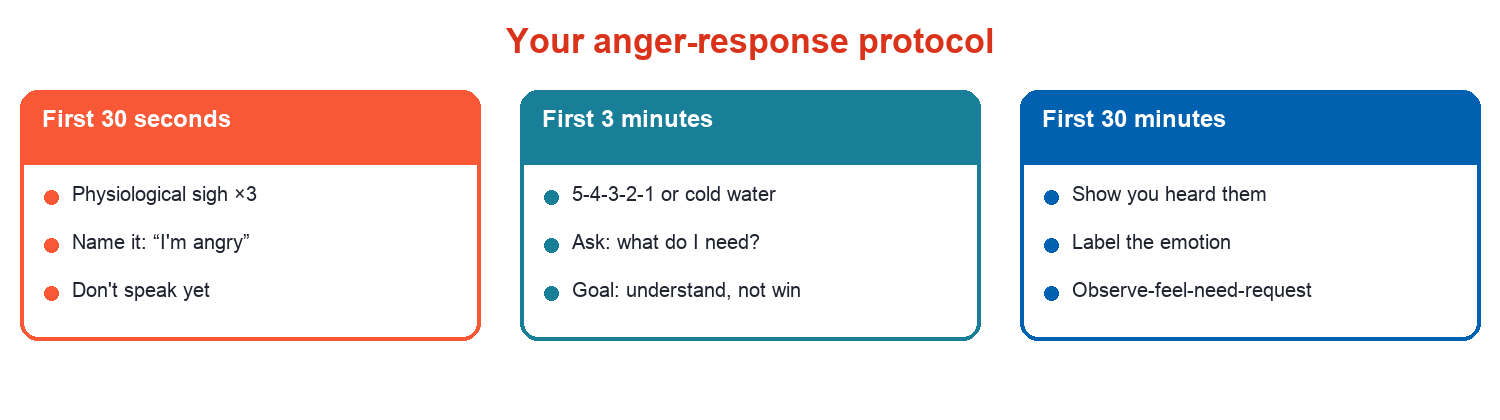
The tools work at different moments, so sort them by the clock:
In the first 30 seconds, the body:\
- Name it silently: "I'm angry. This is the wave."\
- Take one to three physiological sighs: two breaths in through the nose, one long breath out.\
- Don't speak yet, above all when you are past your tool line on the ladder.
In the first 3 minutes, stabilise:\
- Ground yourself: feet on the floor, 5-4-3-2-1, or cold water.\
- Let the wave run out: unfed, the surge passes in roughly ninety seconds, and every replay of the story restarts it.\
- Ask: what do I need right now?
In the first 30 minutes, engage:\
- Listen first, and label what you hear in the other person.\
- Say your side as a clean sentence: observation, feeling, need, request.\
- If either of you is flooded, pause with a named return.
Afterwards, mend: one three-target repair after every blowup. And every day, one line in your anger log.
Two notes on the science. The ninety seconds is an observation by the brain scientist Jill Bolte Taylor, not a lab constant. The physiological sigh has a trial behind it as a daily five-minute practice, run by a Stanford team led by Melis Balban and David Spiegel. Using it mid-surge rests on the mechanism, which is sound.
If choosing is too much, take the book's default set. Run the HALT-S check at your worst hour and the hot-moment protocol for surges. Once the wave has passed, use the clean sentence, and after every blowup, a three-target repair. HALT-S asks whether you are hungry, angry already, lonely, tired or stressed.
In real life: Lukas gets a sharp text from his sister about their mother's birthday. He feels his jaw tighten and names it: "I'm angry. This is the wave." He takes three long exhales, puts the phone face down and lets the wave pass without replaying the message. Underneath he finds hurt, and a need to feel they are on the same side. Twenty minutes later he calls instead of texting: "Your message stung. I want us to be on the same side about this. Can we plan it together?"
🎯 Takeaway: Under pressure you follow either a plan or the reflex. Write the plan now, while you are calm, so it is there when you are not.
Try this
Write your own protocol on one card. Choose one tool each for the first 30 seconds, the first 3 minutes and the first 30 minutes. Test each against the scene you most often get wrong: if a tool wouldn't survive that scene, swap it.
📱 In the app: Panic Button
📖 Go deeper: The Anger Signal, Chapters 10 and 31