
Grounding and Sensory Anchoring
When anger floods your thinking, your senses still work. Grounding uses them as a way out of your head.
When you are flooded, your attention is locked onto the provocation and spinning inside the story. Grounding moves it onto your physical senses on purpose. The flood can take over your thinking, but it cannot switch off your sight, your hearing or your touch.
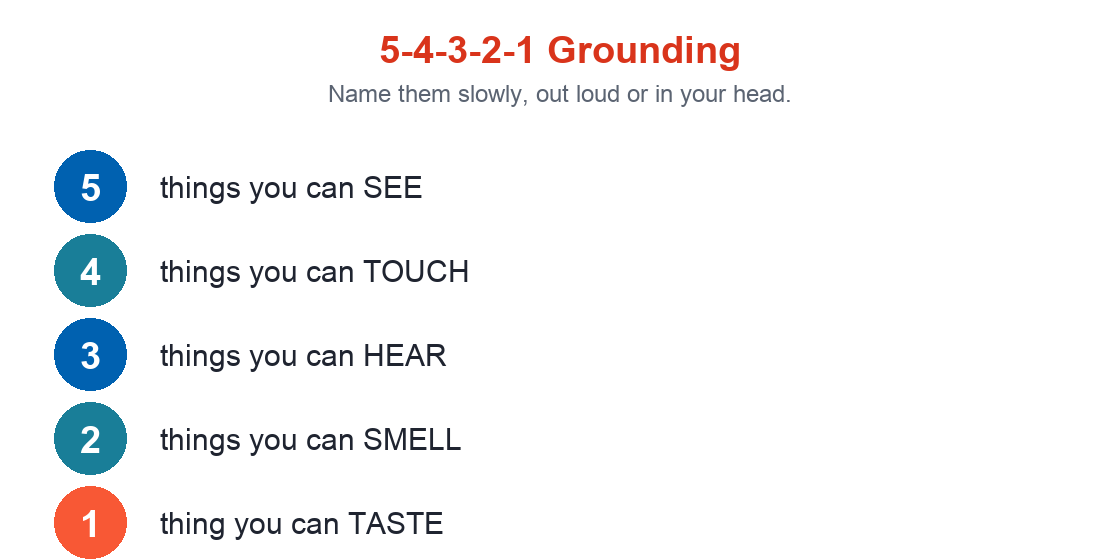
The classic tool is 5-4-3-2-1: name five things you can see, four you can touch, three you can hear, two you can smell and one you can taste. It sounds too simple to matter. It matters because while you are counting ceiling tiles and traffic noises, you are not refueling the wave.
One honest caveat: the countdown itself comes from clinical practice, and no stack of trials tests that exact sequence. The evidence is for the underlying move, shifting attention onto the senses to break the replay. So any sense-by-sense order you will actually use is the right one.
The sharpest grounding tool is cold. Cold water on the face sets off the dive reflex, an automatic response that slows your heart. It is the closest thing your nervous system has to a hard reboot. Because it works by slowing the heart, ask your doctor first if you have a heart condition, and use your wrists rather than your face until then.
In real life: After a blow-up at home, Lukas goes to the bathroom and holds his face and wrists under cold running water for half a minute. His breathing slows and his jaw loosens. He runs 5-4-3-2-1 in his head while he dries his hands. Ten minutes later, as promised, he goes back to the conversation, calm enough to listen.
🎯 Takeaway: High on the ladder, get out of your head and into your senses. Count what is around you, or use cold water to slow your heart.
Try this
Run 5-4-3-2-1 right now, slowly, out loud or in your head. When you reach the one thing you can taste, notice what has changed in your body and in your thoughts.
📱 In the app: Tools → Grounding
📖 Go deeper: The Anger Signal, Chapter 12