
"I" Statements vs. "You" Statements
Start an angry sentence with "you always" and the other person stops listening before you reach the verb. The same anger, said as what you saw, felt and need, gives them something they can answer.
"You" plus anger registers as an attack: the other person's alarm fires, and an attacked brain has exactly one priority, which is to defend. Listening is not on that list. You can be completely right and it won't matter, because content can't reach them in that state. Brain scans even suggest that social rejection runs partly on the same circuitry as physical pain. Marshall Rosenberg, who built Nonviolent Communication, called blame the language that guarantees the message won't land.
Blame and the clean version come from the identical feeling. "You're so inconsiderate" is the alarm, thrown at them. Underneath sits a signal: I feel unimportant, and I need to know I matter to you. The blame makes them defend, while the signal lets them see you.
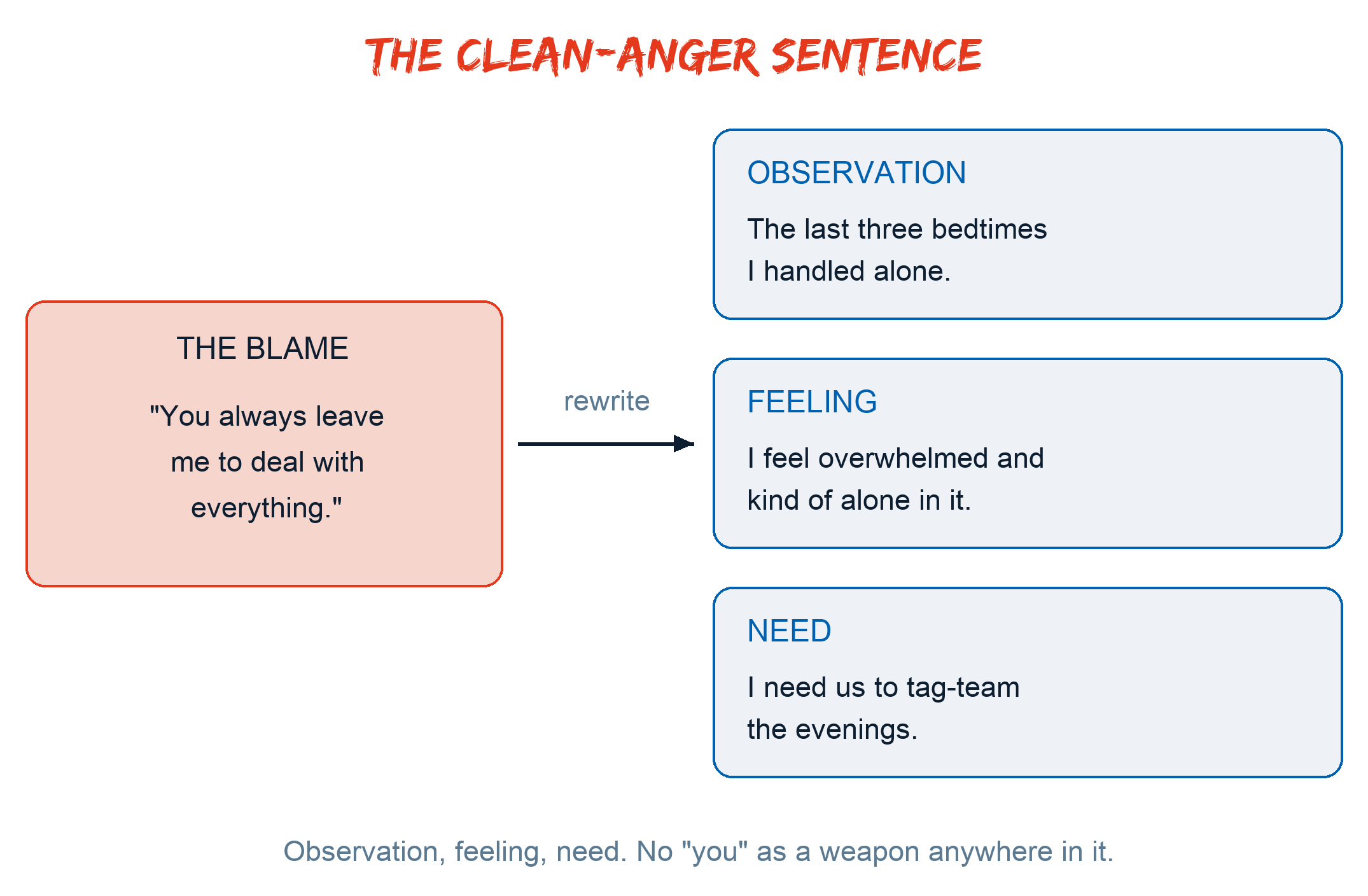
The book's tool is the clean-anger sentence, built from three parts:\
- Observation: what a camera would have recorded. "The last three bedtimes I did on my own."\
- Feeling: something happening inside you. "Overwhelmed" passes. "Abandoned" fails, because it describes what they did.\
- Need: what you are missing. "I need us to share the evenings."
Watch for faux feelings: "I feel disrespected", "ignored" or "manipulated" sound like feelings and are verdicts about the other person. They hear the blame straight through the costume. Real feelings implicate no one: hurt, scared, lonely, frustrated, tired.
The clean sentence removes your half of the fight and leaves their half where it was. Someone braced by years of blame may still hear an accusation the first few times. You keep using it because the old way made things worse every time.
In real life: Viktoria has done the evening clean-up alone three nights running. Usually she says nothing about it, which is its own message. The sentence loading in her mouth is "You never lift a finger in this house." She runs the swap instead. Camera fact: three nights. Real feeling: tired, and a bit invisible. Need: to feel like a team. What comes out is: "The last three nights I've cleaned up on my own after the kids were down, and I'm wiped. Can we work out a split?" Lukas answers defensively the first time, and she doesn't add the second sentence that would prove his reading right. She says, "Three nights, and I'm tired," and stops.
🎯 Takeaway: Report the fire instead of throwing the alarm: observation, feeling, need. That gives the other person nothing to defend against and something real to answer.
Try this
Take "You never help with the kids!" and rebuild it as a clean-anger sentence. Write the camera fact, run the faux-feeling test on your feeling word, name the need, and read the finished sentence aloud. Check that no "you" is left in it as a weapon.
📱 In the app: Learn → Communication
📖 Go deeper: The Anger Signal, Chapter 14