
The Anger Spectrum
Anger rarely goes from zero to a hundred. It climbs, and most people only notice once it is already loud.
The psychologist Lisa Feldman Barrett studies emotional granularity: how finely you can tell your own feelings apart. Her team gave people small devices that beeped at random moments for weeks. At each beep they recorded what they were feeling. Some described every bad moment with the same few words. Others told irritation apart from disappointment and from resentment.
The fine-grained group regulated their emotions better: they reached for more strategies when a feeling hit, and they lashed out less. You can only steer what you can tell apart.
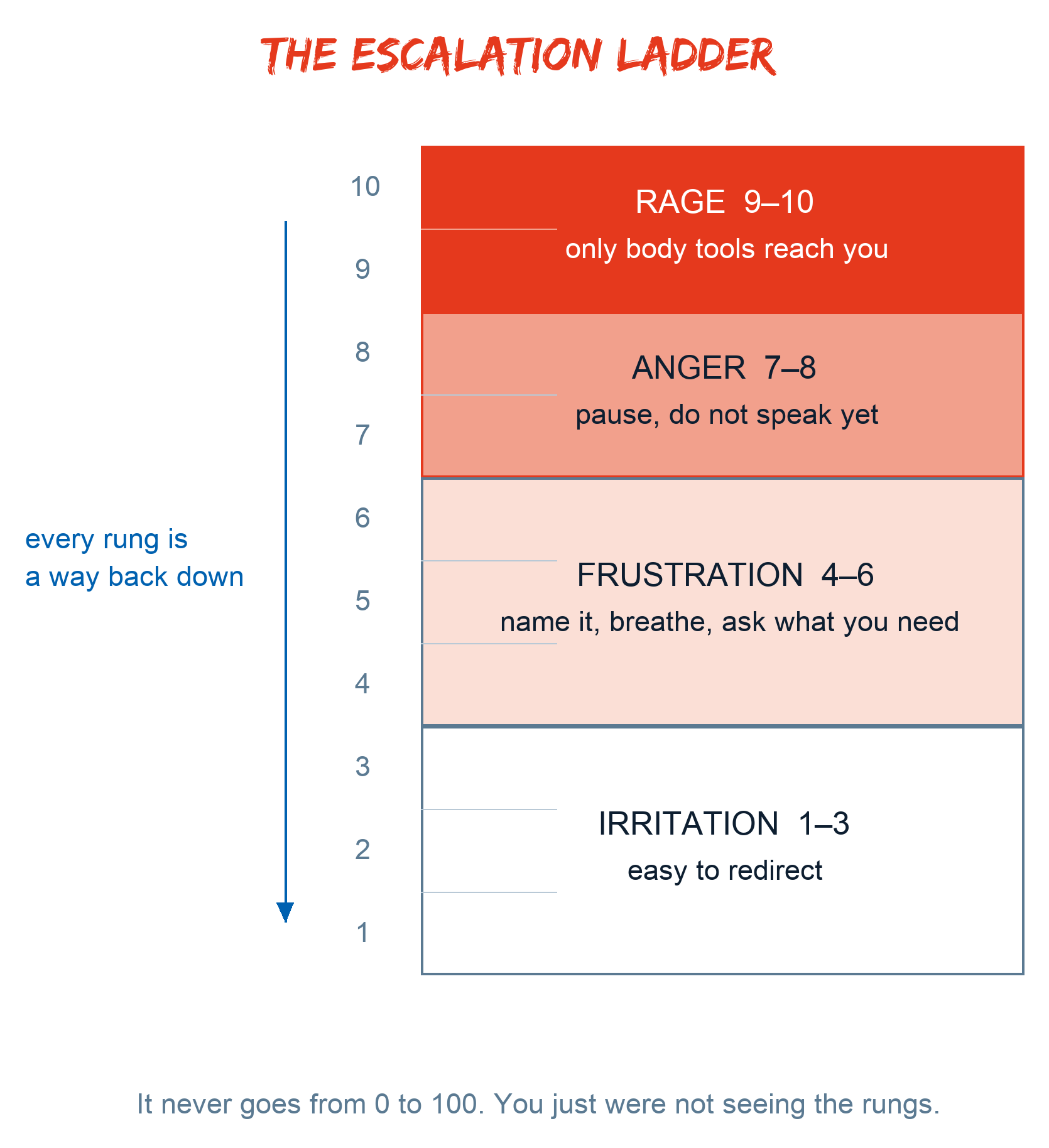
That is why Chapter 4 of the book draws anger as a ladder. Each rung has a name, and on each one a different amount of you is still in charge:\
- irritation, a background hum, with your thinking brain fully online;\
- frustration, the first step most people notice, with heat in the chest;\
- anger, where your attention narrows onto the provocation;\
- rage, where the alarm has outvoted your judgment and the damage happens.
Your ladder may have four steps or seven. What matters is the climb. The calming tools in this course work well low on the ladder and fail near the top. So the skill is to notice early, while you still have choices.
Suppressed anger climbs too, just quietly. It shows up as a clipped "fine", as sarcasm, as tiredness or as a cold silence that lasts for days.
In real life: Viktoria has been short with everyone at the GP practice for three days. If anyone asked, she would call it tiredness. When a colleague mislabels a file, she snaps, and it surprises them both. Looking back, she had been sitting at a quiet 4 out of 10 all week, saying "fine" through a tight jaw.
🎯 Takeaway: You can only steer what you can name. Learn to name the quiet part of the climb, and the jump from zero to a hundred turns out to be a staircase you can see.
Try this
Draw your own ladder as Chapter 4 of the book does: three to seven rungs, in your own words, each with a number from 0 to 10. Mark where you usually first notice your anger. Then mark where you are right now.
📱 In the app: Tools → Emotional Check-In
📖 Go deeper: The Anger Signal, Chapter 4