
Where Does Anger Come From?
The trigger is rarely the whole story. When your reaction is bigger than the thing in front of you, the size of the gap is the clue.
Picture an iceberg. Anger is the tip above the waterline, loud and visible. Underneath sits the bigger mass: hurt, fear, shame, and powerlessness. The psychologist Leslie Greenberg calls anger a secondary emotion. It shows up to guard a softer feeling, because anger feels big where hurt feels small.
When your fury outruns the trigger, something underneath is usually doing the work. These are the most common sources:\
- an old script, the way anger was done in the house you grew up in;\
- a feeling converted on the way up, because it was never allowed out under its own name;\
- an unmet need, such as respect, safety, fairness or the plain need to matter;\
- a load you were already carrying before the trigger arrived;\
- a grief you have not set down.
The script deserves a second look. You absorbed your family's way of doing anger long before you could judge it. Some people copy it exactly, and others spend their lives over-correcting against it. Either way it was learned, so it can be rewritten.
Some people say that anger is all that ever comes out. Picture a funnel with one open spout at the bottom. If you were taught that sadness, fear or shame were off-limits, they all drain out through the one feeling you were allowed: anger. Naming them earlier widens the funnel.
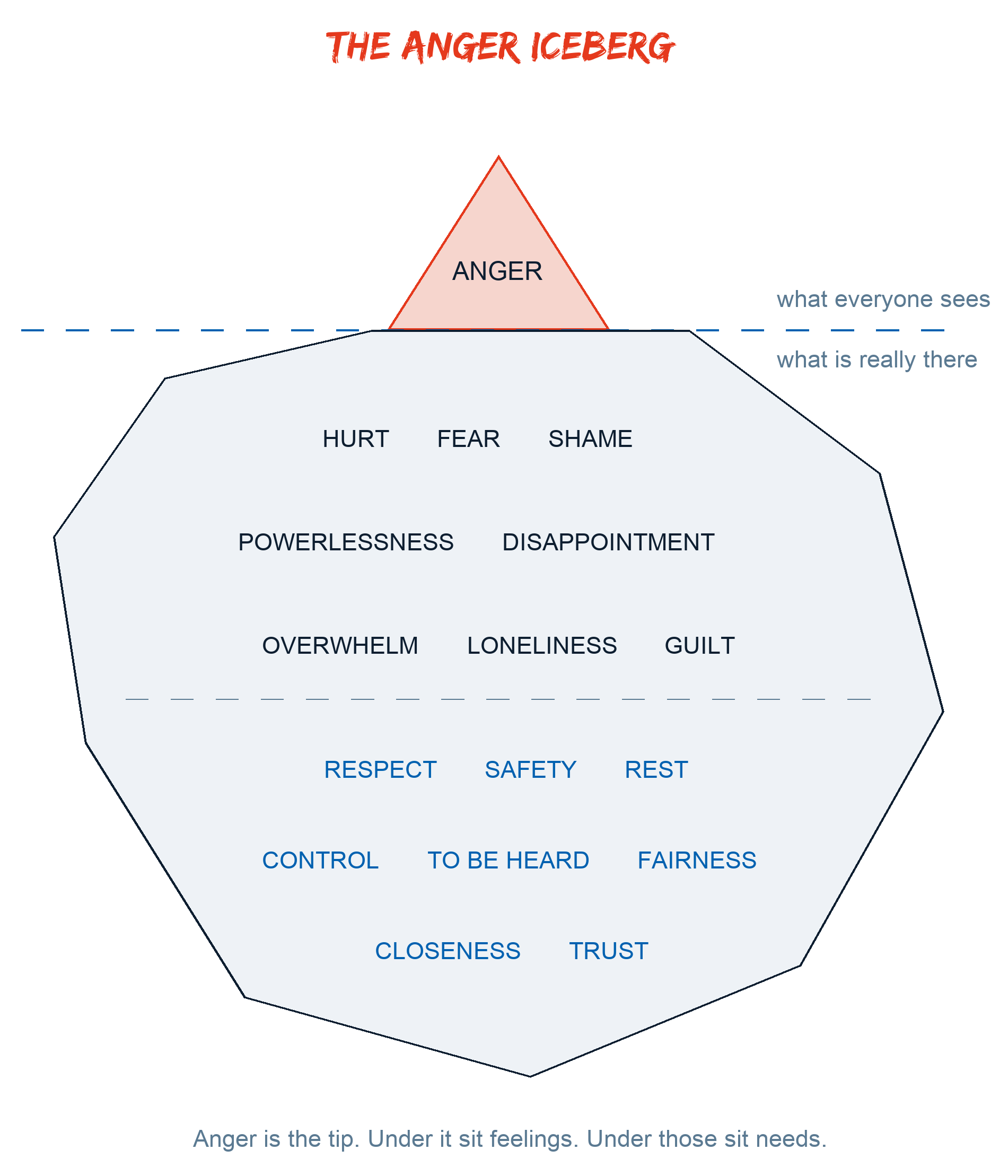
In real life: Viktoria asks Lukas whether he has booked the car service, and adds, "You always forget this stuff." He explodes. The trigger was one sentence about a car. Under it sat hurt: he works hard to be someone who keeps his word, and "always" told him he had failed. The trigger was small. The charge underneath was old.
🎯 Takeaway: Anger usually guards something softer: hurt, fear, shame or powerlessness. Disproportion is the clue, and curiosity about what sits underneath is the way in.
Try this
Run a short Iceberg Dig on your index incident. Write the trigger the way a camera would have seen it. Score the trigger and your reaction from 0 to 10 each. If the reaction is three or more points higher, ask: if I weren't angry here, what would I have to feel? Write down whatever comes up, and the need it might be guarding.
📖 Go deeper: The Anger Signal, Chapter 3