
Progressive Muscle Relaxation
Anger readies your muscles for a fight that almost never comes. Tensing and releasing them on purpose lets that charge go.
Anger is a full-body preparation for action. The alarm sends fuel into your muscles, and in modern life the fight almost never happens. So the charge sits there, in a clenched jaw, raised shoulders and tight fists. That is why you pace after an argument and why your hands shake.
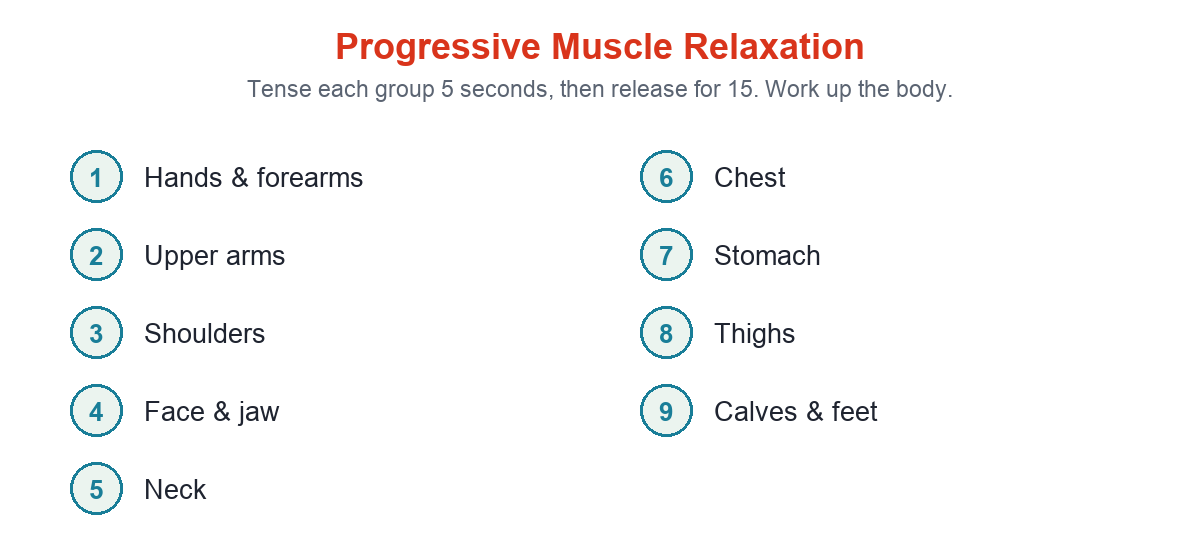
Progressive muscle relaxation goes back to Edmund Jacobson, who published it in 1938. You tense one muscle group and hold it for five to eight seconds, before letting go completely for fifteen to twenty seconds. Work through the body in order: hands, forearms, upper arms, shoulders, face, neck, chest, stomach, thighs, calves, feet.
The contrast teaches you what release feels like in each part of the body. With practice you notice tension earlier, which sharpens your body's early warning signs.
The book uses the same move in two ways. In the moment, you can squeeze and release your fists under the table to discharge energy when you cannot leave. On calm days, a slow head-to-toe release is a good way to relax deeply before you rehearse a calm response.
In real life: Viktoria does a short muscle release every evening for three weeks. In the first week she notices that her shoulders are always up near her ears, which she had never registered. By the third week she catches them rising during the working day and lets them drop before the tension turns into a headache.
🎯 Takeaway: Anger lives in your muscles as well as your mind. Tense and release on calm days, and squeeze your fists under the table when you can't leave the room.
Try this
Make a tight fist with both hands and hold it for eight seconds. Let go completely and notice the moment of release. Where else in your body are you holding tension right now?
📱 In the app: Tools → Grounding
📖 Go deeper: The Anger Signal, Chapters 12 and 13