
The Anger Escalation Ladder

Anger climbs a ladder, and every step is a chance to come back down. The lower you catch it, the more of you is still in charge.

Chapter 4 of the book names the rungs: irritation, frustration, anger, rage. On each higher rung your thinking narrows, your body revs higher and your options shrink.

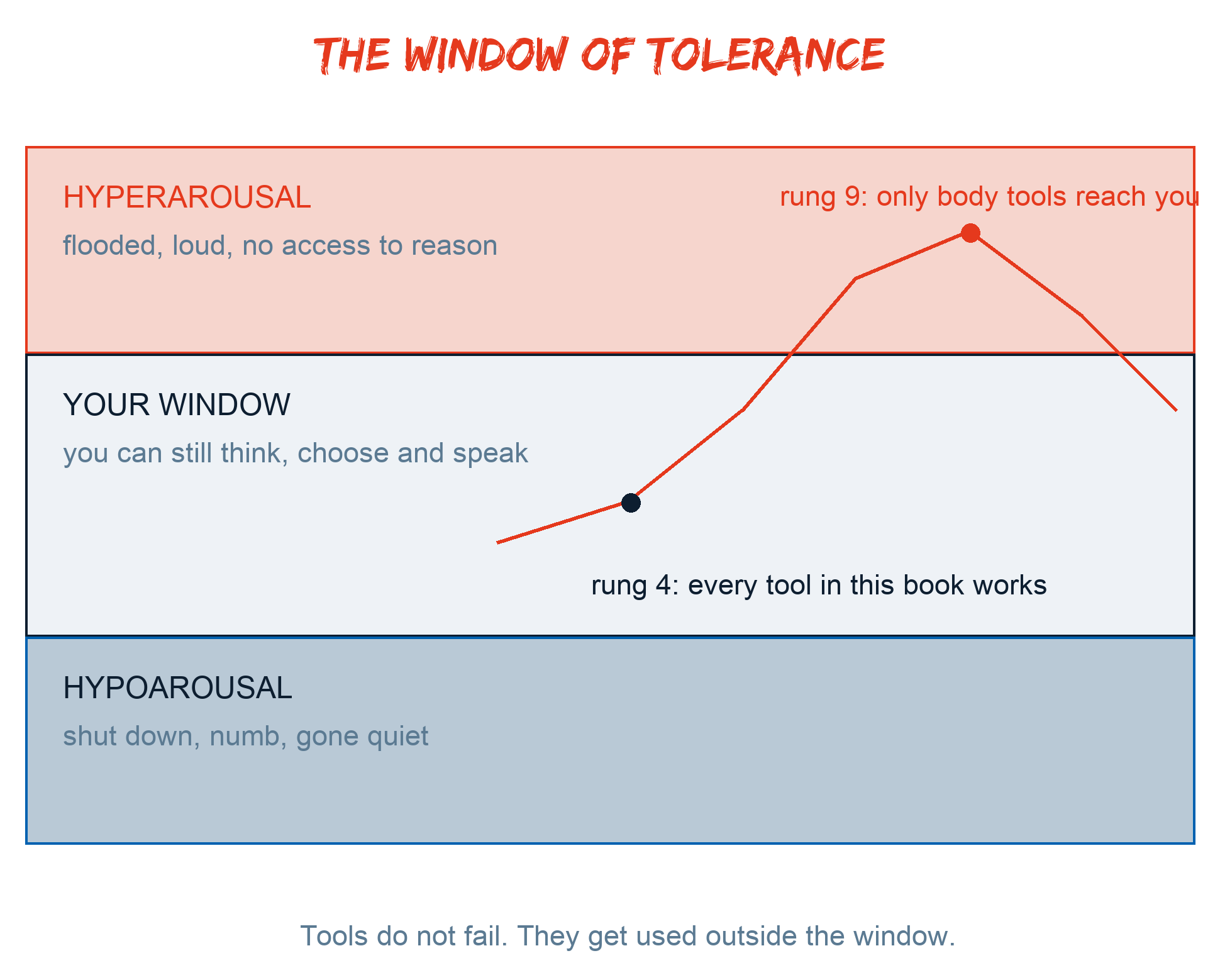
The key mark on your ladder is the tool line, usually around 6 or 7. Below it, the calming tools work: a long exhale, a second look at the story, naming what you feel. Above it they stop working, because the part of you that would use them has been outvoted. Above the line, the move is to leave the room, discharge the energy with movement, and come back once you have calmed down.

The psychiatrist Dan Siegel describes the same edge from the inside. He calls the zone in which you can still think and feel at the same time the window of tolerance. Inside it you can be angry and reasonable at once. Above it you are flooded. Your tool line is the top edge of that window.

Naming your level helps twice. Putting a feeling into words quiets the alarm a notch, an effect Matthew Lieberman measured in a brain scanner. And knowing you are at a 4 tells you which tools still work at that height.
The Anger Escalation Ladder

In real life: Lukas's manager criticizes his report in front of the team. He notices the irritation, about a 2, and takes one slow breath. In the corridor a colleague jokes, "Rough day?" Now he is at a 4, and he notices that too. He says, "Give me five minutes," walks to the kitchen and breathes out slowly until he is back at a 2. Without the naming, that 4 could easily have become a 7.

🎯 Takeaway: Name your level as you climb. Below your tool line, calm yourself where you stand. Above it, leave, move and come back once you are inside the window again.

Try this

Think of a recent episode. At what level did you first notice your anger, and where did it peak? Decide where your tool line sits, and write one sentence for what you will do when you cross it.

📱 In the app: Tools → Emotional Check-In

📖 Go deeper: The Anger Signal, Chapters 4 and 7

From the Blog

Beyond the Boiling Point: When Anger Needs More Than Self-Help

Most anger is normal. Some anger is a sign something more is going on. Here's how to tell the difference, and what to do about it.

Read the article →

How to Control Anger: A Stage-by-Stage Guide

Anger control isn't one skill, it's three, and each one only works at a certain level of heat. Learn to rate your anger from 1 to 10 and pick the tool that fits the stage.

Read the article →

ADHD and Anger in Adults: The Overlooked Connection

Your anger might not be a character flaw. For a lot of adults with ADHD, it's the same brake system that struggles with focus, now struggling to catch a big feeling too.

Read the article →

Why Alcohol Makes You Angry

Alcohol doesn't create a different, meaner version of you. It sedates the part of your brain that normally stops the fight before it starts.

Read the article →

Rage Attacks: Why They Happen and How to Stop Them

It feels like it comes out of nowhere: one second you're fine, the next you're screaming and can barely remember it. Here's what's actually happening, and how to catch it earlier.

Read the article →

What Happens in an Anger Management Class

Your partner gave you an ultimatum, or a judge did, and now you're picturing a room full of strangers yelling. Here's what the sessions actually involve.

Read the article →

Gamer Rage: Why Losing Makes You Want to Break Things

Rage-quitting and controller-throwing aren't a character flaw. Games are built to hook you, ranked ladders attach your worth to the score, and lag makes it worse. Here's what's actually happening, and what breaks the spiral.

Read the article →

Anger Blackouts: Why You Can't Remember What You Said

You come down from a fight and there's a hole where the worst part should be. That's not denial. Here's what an anger blackout actually is, and why it still counts.

Read the article →

Why You Want to Break Things When You're Angry

The urge to smash something is real fight energy looking for a target. Here's what that urge actually is, what breaking things trains your brain to do, and what discharges it without the cost.

Read the article →

When Your Own Anger Scares You

It's not the other person you're afraid of. It's what happens inside you. Here's why that fear makes sense, and how to tell if it's a warning worth acting on.

Read the article →

Am I the Angry One, or Am I Reacting?

You're calm everywhere else and furious with one person. That pattern tells you something specific, and it isn't that you're an angry person.

Read the article →

Continue in The Anger App

All 32 lessons, interactive, in the app, Premium; the Panic Button stays free.

Get the free workbook
The Anger Escalation Ladder · Anger Course · The Anger App