
The Cool-Down Before the Conversation

A conflict and the conversation that resolves it are two separate events. Trying to hold both at once while you are flooded makes the fight worse.

John Gottman wired couples to heart-rate monitors and watched them argue. His rule of thumb: once a person's heart rate climbs past roughly 100 beats per minute, fair fighting is over for the time being. He calls this flooding, and in that state the thinking brain is mostly offline: you can't take in what the other person says, however hard you try.

So the cool-down is what makes resolution possible. Gottman's advice is to give a flooded body at least twenty minutes to settle, and often longer. Feeling calm arrives before being calm, which is why a fight paused for three minutes flares up again at the next wrong word.

What separates a pause from stonewalling is a named return. "I want to sort this out, and I'm too flooded to do it well. Let's stop and pick it up at eight." A pause without a return time reads as abandonment, while a pause with one is a promise.

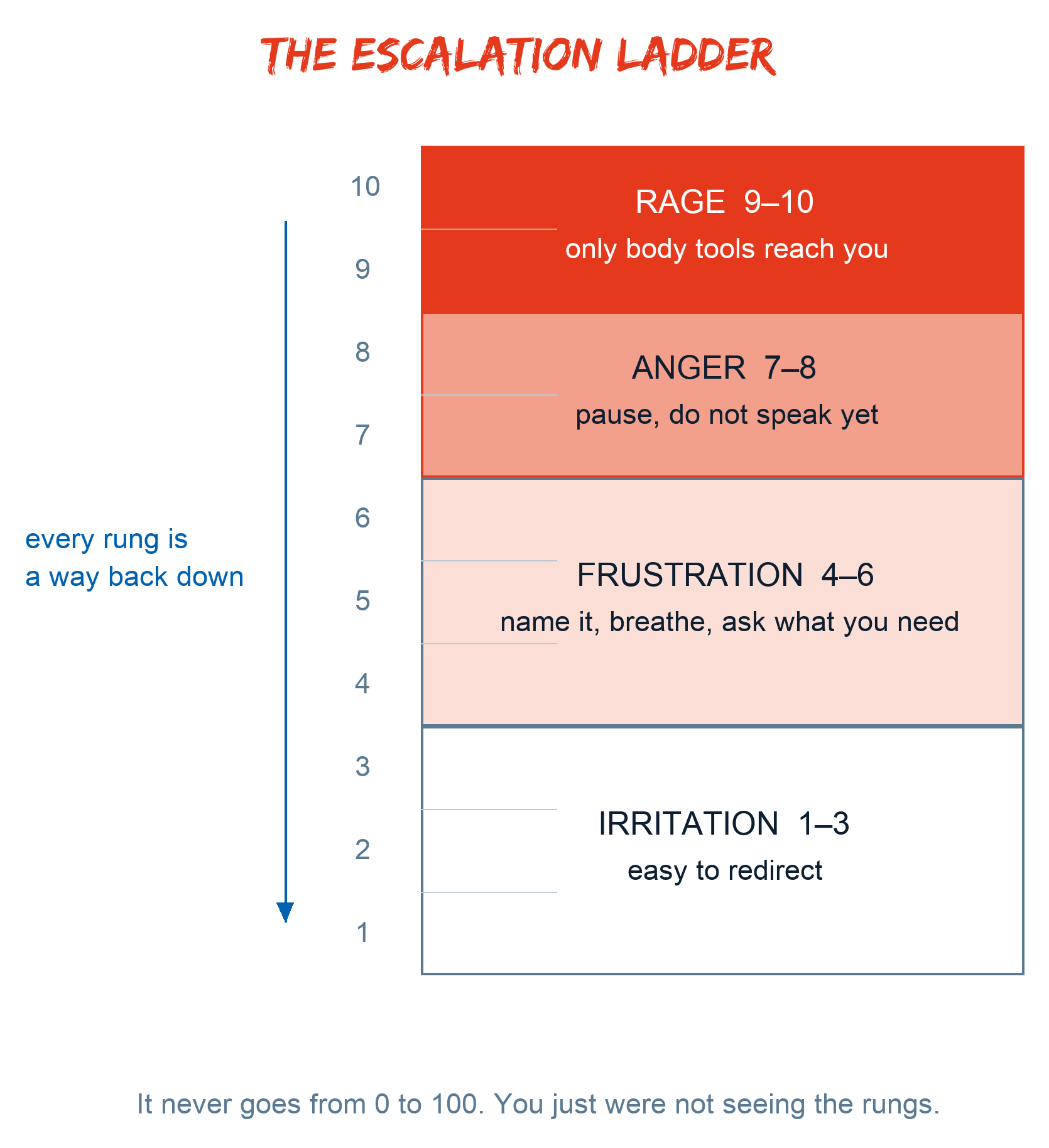
Your ladder from the book's chapter 4 helps here. Above your tool line, calming techniques stop working, and the only move is to leave the room and discharge the tension through your big muscles. When you come back, open softly with a clean sentence, because the first minutes of a conversation tend to set where it goes.
The Cool-Down Before the Conversation

In real life: Over dinner Lukas and Viktoria start arguing about the summer holiday. Lukas feels his chest tighten and his voice rise. He says: "I want to work this out, and I'm too heated to do it well. Can we talk at nine, after the kids are asleep?" Viktoria agrees, and he takes the dog round the block and breathes out long and slow. At nine he opens softly: "I've calmed down, and I still want to sort this out with you." They have the same conversation, and this time both of them can listen.

🎯 Takeaway: Pause with a named return, give your body at least twenty minutes, and come back in softly. A pause with a return time is how a fight gets finished well.

Try this

Write your pause sentence now, while you are calm: what you will say, the return time you will name, and what you will do during the twenty minutes. Agree it with the person you argue with most, before you need it.

📱 In the app: Tools → Grounding

📖 Go deeper: The Anger Signal, Chapter 22

From the Blog

What to Say When You're Furious (Scripts That Don't Blow Up)

When you're furious, the wrong words make it worse. Here are simple scripts for buying time, naming what you need, and repairing after.

Read the article →

Why You Regret the Things You Say in Anger

The cruel thing you said wasn't the real you. During peak anger, the part of your brain that reasons goes offline. Here's the biology, and the repair.

Read the article →

How to Apologize After Losing Your Temper (and Mean It)

You snapped, and now you feel awful. A real apology is a skill, not a grovel. Here's how to repair the damage in a way that actually rebuilds trust.

Read the article →

How to Stay Calm at Work (When You Want to Explode)

The passive-aggressive email, the meeting that ignores your point, the manager who takes credit. Here's how to stay calm at work without swallowing it or blowing up.

Read the article →

Why Arguments Get Worse Over Text

Text strips out tone, face, and timing all at once. Here's why your brain fills that gap with the worst possible read, and what actually stops the spiral.

Read the article →

Surviving Family Holidays Without a Blowup

Old roles, no sleep, one dining room. Here's a pre-game, in-game, and post-game plan for getting through the holidays without the blowup.

Read the article →

Why Your Mind Goes Blank in an Argument

You freeze mid-fight, then the perfect reply shows up an hour later in the shower. Here's why your brain empties in conflict, and what to do about it.

Read the article →

How to Respond to an Angry Email Without Making It Worse

A rude email lands and your heart rate spikes. The reply you want to send right now is the one you'll regret. Here's the calmer way to answer it.

Read the article →

How to Rebuild a Friendship After a Blowup

You said too much, or they did, and now there's cold silence where a friend used to be. Here's the plain path back, if the friendship is worth saving.

Read the article →

Co-Parenting Anger: Furious at Someone You Can't Leave

You separated to stop the fighting, and now the fight has a schedule. Here's why co-parenting anger runs hotter than it did in the marriage, and what actually lowers it.

Read the article →

How to Tell Your Partner You Have an Anger Problem

You've decided to work on it. Now you have to say it out loud to the person it has cost the most, without turning the conversation into a plea for reassurance.

Read the article →

When Doctors Don't Believe You

Being told it's stress when you know something is wrong produces a specific kind of rage. Here's why it cuts so deep, and how to use the anger without it costing you the appointment.

Read the article →

Arguing in a Second Language: Why It's Worse

You lose arguments you would win in your own language, and then you're furious at yourself for hours. There is real research on this, and one finding works in your favour.

Read the article →

Continue in The Anger App

All 32 lessons, interactive, in the app, Premium; the Panic Button stays free.

Get the free workbook
The Cool-Down Before the Conversation · Anger Course · The Anger App