
Breathing to Calm the Storm
Your breath is the one part of your automatic nervous system you can steer by hand. The secret is in the exhale.
You cannot slow your heart by deciding to. Breathing is different: it runs on its own, yet you can take over at any moment. That makes it the one direct lever into your stress system.
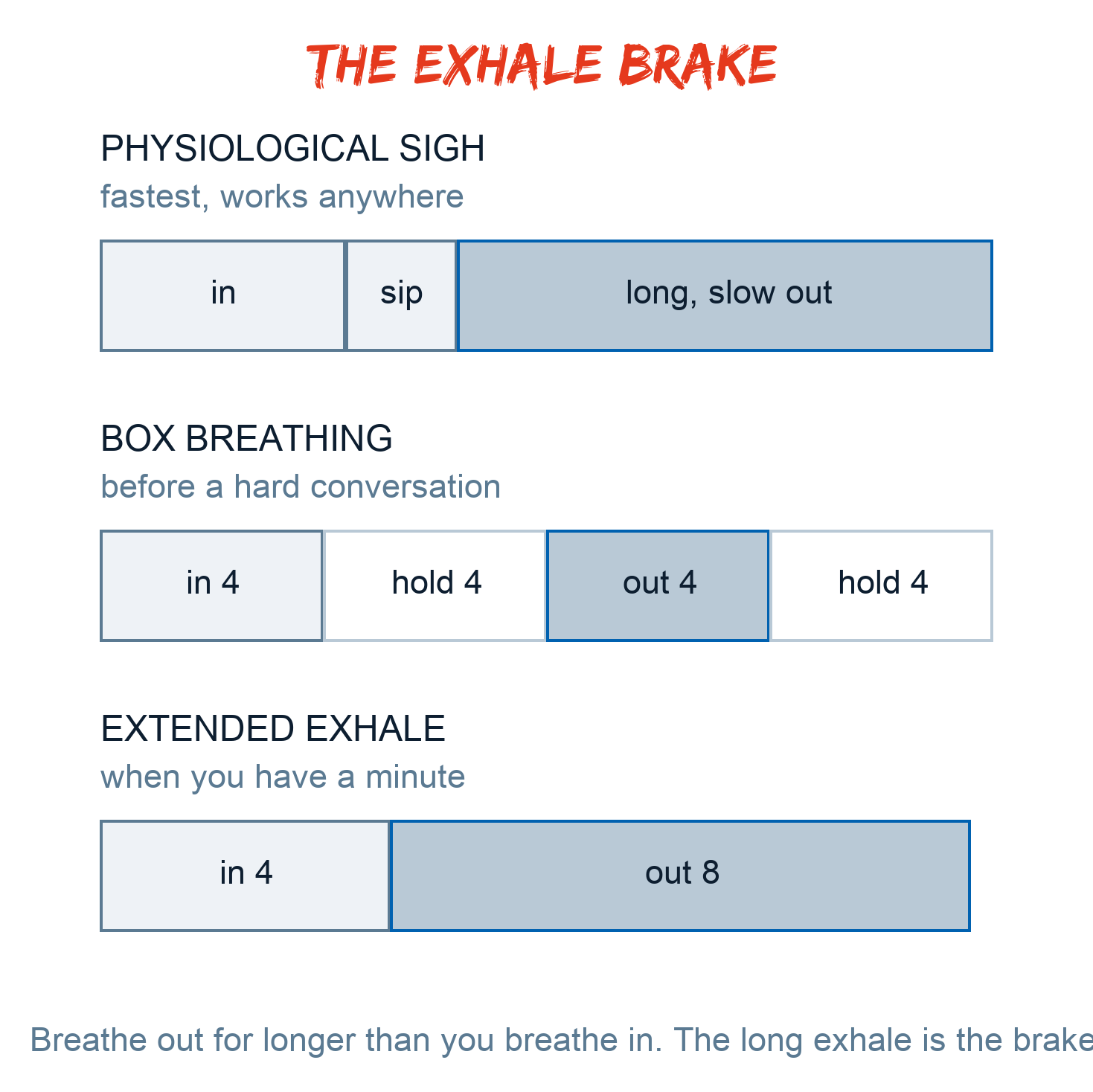
The vagus nerve is the main cable of your rest-and-digest system. When you breathe in, your heart speeds up slightly. When you breathe out, the vagus nerve slows it down. So the exhale is the brake: make your out-breath longer than your in-breath, and you press it by hand.
That is why "take a deep breath" so often backfires. People hear "deep" and pull in a big, sharp breath, which presses the accelerator.
Three techniques, one principle:\
- The physiological sigh, the fastest: a full breath in through the nose, a short sip on top, then a long, slow breath out through the mouth.\
- Box breathing, for a long, hard conversation: in for four, hold for four, out for four, hold for four.\
- 4-7-8, for winding down afterwards: in for four, hold for seven, out for eight.
The sigh is often oversold, so here is what was measured. A Stanford team led by Melis Balban and David Spiegel compared five minutes of cyclic sighing a day with five minutes of mindfulness meditation for a month. The sighing group did better on mood and on resting breathing rate. Taking a few sighs in the middle of a surge is backed by the mechanism; that trial did not test it.
Two cautions apply. Breathing works low on the ladder and fails near the top, so use it early. And if focusing on your breath makes you dizzy, tingly or detached, stop and switch to grounding.
In real life: Lukas has a hard conversation with his manager at ten. At 9:50 he stands in the corridor and does three physiological sighs, each exhale longer than both inhales together. His heart settles a little, and he walks in at a 2 instead of a 4, which leaves him more room before he reaches his tool line.
🎯 Takeaway: Long exhale, early. The out-breath is the brake, and it works best before the heat has climbed too high.
Try this
Try the physiological sigh now: a full breath in through the nose, a short sip on top, a long, slow breath out through the mouth. Do three. Put a hand on your chest and notice it settle on each out-breath.
📱 In the app: Tools → Breathing
📖 Go deeper: The Anger Signal, Chapter 11