
The Anger Escalation Ladder
Anger climbs a ladder, and every step is a chance to come back down. The lower you catch it, the more of you is still in charge.
Chapter 4 of the book names the rungs: irritation, frustration, anger, rage. On each higher rung your thinking narrows, your body revs higher and your options shrink.
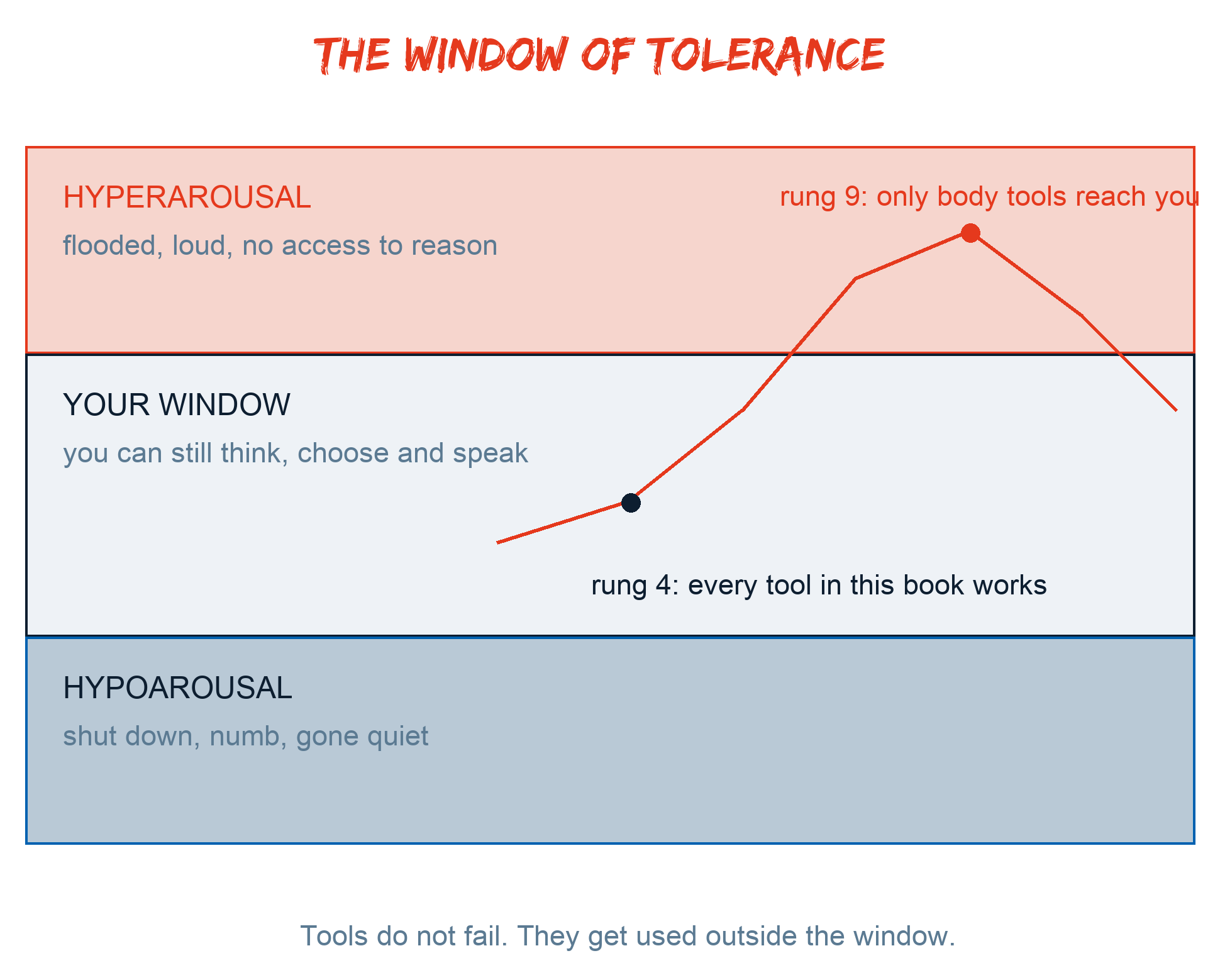
The key mark on your ladder is the tool line, usually around 6 or 7. Below it, the calming tools work: a long exhale, a second look at the story, naming what you feel. Above it they stop working, because the part of you that would use them has been outvoted. Above the line, the move is to leave the room, discharge the energy with movement, and come back once you have calmed down.
The psychiatrist Dan Siegel describes the same edge from the inside. He calls the zone in which you can still think and feel at the same time the window of tolerance. Inside it you can be angry and reasonable at once. Above it you are flooded. Your tool line is the top edge of that window.
Naming your level helps twice. Putting a feeling into words quiets the alarm a notch, an effect Matthew Lieberman measured in a brain scanner. And knowing you are at a 4 tells you which tools still work at that height.
In real life: Lukas's manager criticizes his report in front of the team. He notices the irritation, about a 2, and takes one slow breath. In the corridor a colleague jokes, "Rough day?" Now he is at a 4, and he notices that too. He says, "Give me five minutes," walks to the kitchen and breathes out slowly until he is back at a 2. Without the naming, that 4 could easily have become a 7.
🎯 Takeaway: Name your level as you climb. Below your tool line, calm yourself where you stand. Above it, leave, move and come back once you are inside the window again.
Try this
Think of a recent episode. At what level did you first notice your anger, and where did it peak? Decide where your tool line sits, and write one sentence for what you will do when you cross it.
📱 In the app: Tools → Emotional Check-In
📖 Go deeper: The Anger Signal, Chapters 4 and 7