
The Cool-Down Before the Conversation
A conflict and the conversation that resolves it are two separate events. Trying to hold both at once while you are flooded makes the fight worse.
John Gottman wired couples to heart-rate monitors and watched them argue. His rule of thumb: once a person's heart rate climbs past roughly 100 beats per minute, fair fighting is over for the time being. He calls this flooding, and in that state the thinking brain is mostly offline: you can't take in what the other person says, however hard you try.
So the cool-down is what makes resolution possible. Gottman's advice is to give a flooded body at least twenty minutes to settle, and often longer. Feeling calm arrives before being calm, which is why a fight paused for three minutes flares up again at the next wrong word.
What separates a pause from stonewalling is a named return. "I want to sort this out, and I'm too flooded to do it well. Let's stop and pick it up at eight." A pause without a return time reads as abandonment, while a pause with one is a promise.
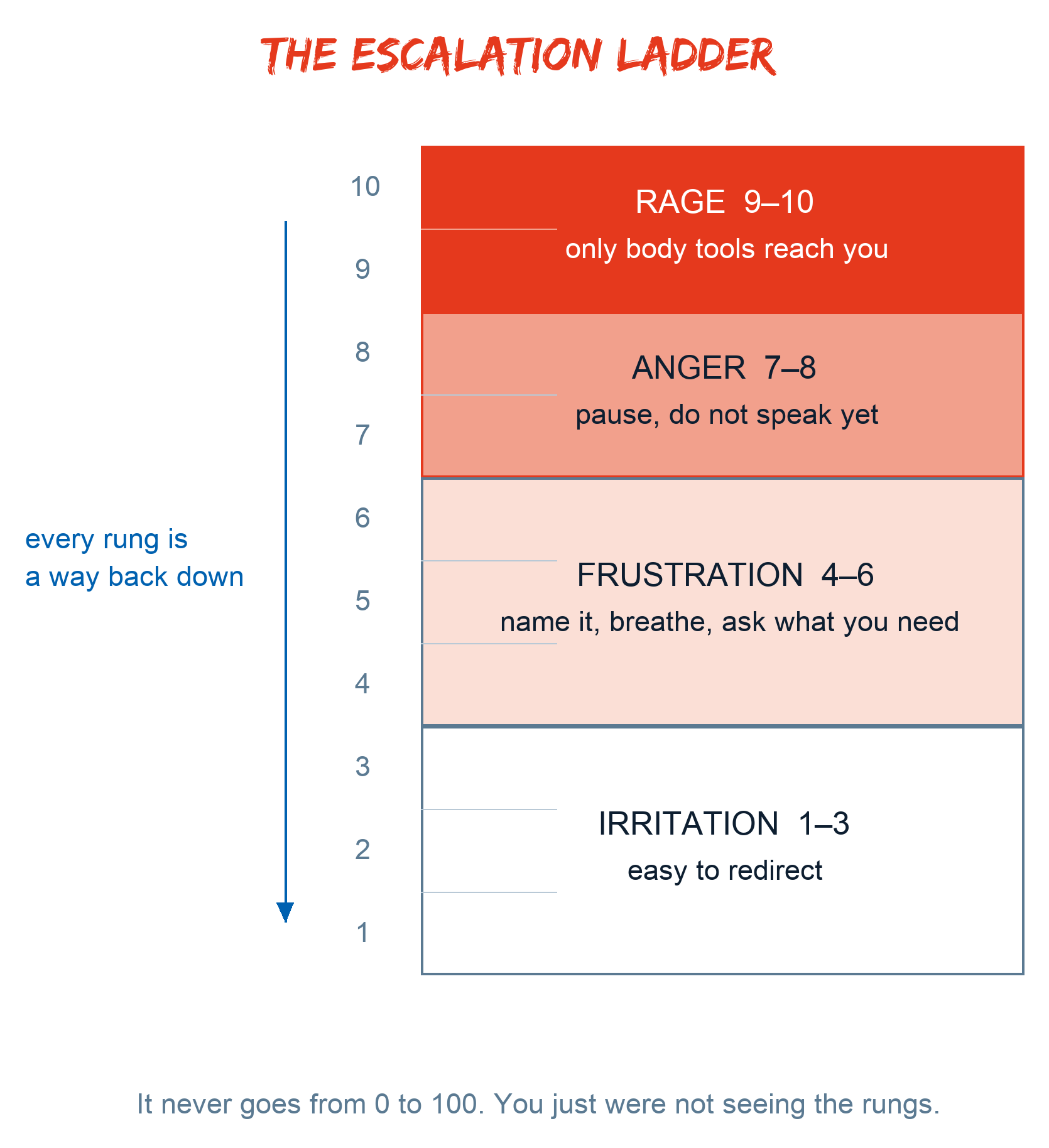
Your ladder from the book's chapter 4 helps here. Above your tool line, calming techniques stop working, and the only move is to leave the room and discharge the tension through your big muscles. When you come back, open softly with a clean sentence, because the first minutes of a conversation tend to set where it goes.
In real life: Over dinner Lukas and Viktoria start arguing about the summer holiday. Lukas feels his chest tighten and his voice rise. He says: "I want to work this out, and I'm too heated to do it well. Can we talk at nine, after the kids are asleep?" Viktoria agrees, and he takes the dog round the block and breathes out long and slow. At nine he opens softly: "I've calmed down, and I still want to sort this out with you." They have the same conversation, and this time both of them can listen.
🎯 Takeaway: Pause with a named return, give your body at least twenty minutes, and come back in softly. A pause with a return time is how a fight gets finished well.
Try this
Write your pause sentence now, while you are calm: what you will say, the return time you will name, and what you will do during the twenty minutes. Agree it with the person you argue with most, before you need it.
📱 In the app: Tools → Grounding
📖 Go deeper: The Anger Signal, Chapter 22