
What Is Anger?
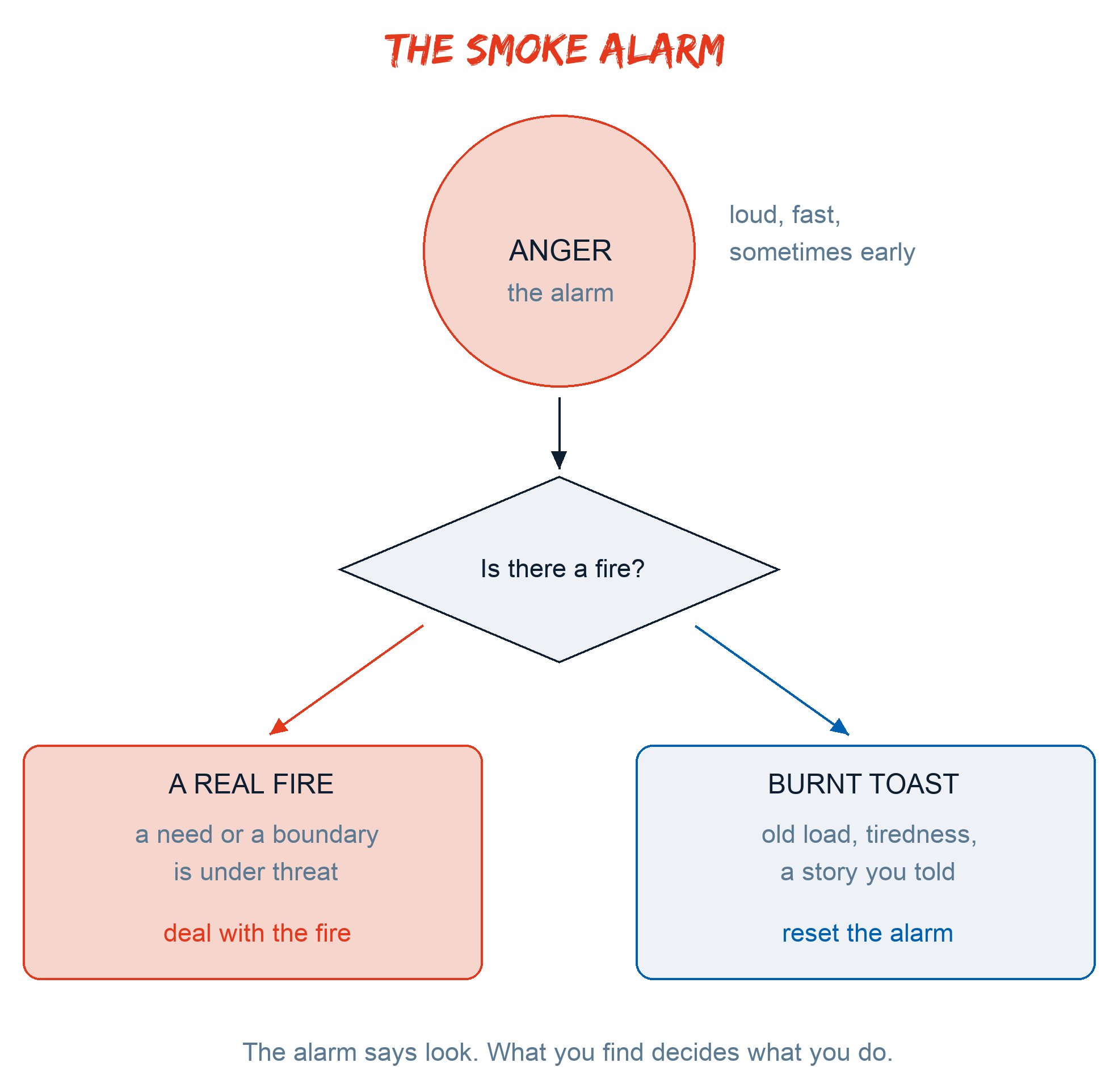
Anger is a smoke alarm. It is loud and unpleasant on purpose, and it has one message: something you care about is under threat.
Deep in your brain sits the amygdala, your threat detector. It flags danger before your thinking brain has worked out what is going on. The neuroscientist Joseph LeDoux spent decades mapping that fast route. It explains why you have already said the sharp thing before you ever decided to say it.
The alarm cannot tell a threat to your body from a threat to your pride. A charging dog and a sneering comment land on the same circuit. You may have heard this called an "amygdala hijack", a phrase from Daniel Goleman. It names the feeling well, but it overstates the case. Under threat your judgment gets outvoted and narrowed. It does not disappear, and that small handhold is what this course trains.
The alarm is also useful. In the early 1980s the psychologist James Averill asked ordinary people to keep diaries of their anger. Most got angry several times a week, mostly at people they loved. Most episodes were conversations rather than fights, and often something important finally got said.
So the goal is a calibrated alarm, one that fires for real fires at a volume the situation deserves. The exploder lets the siren blast at every wisp of smoke. The suppressor pulls the battery. Neither of them ever finds the fire.
In real life: Lukas is at the stove at 18:47 and has asked his nine-year-old son three times to set the table. The boy stays on his tablet, so Lukas reaches past him, knocks over the apple juice and shouts far louder than he meant to. His alarm was right that something mattered: he feels invisible in his own home. The volume and the target were wrong. Yelling at a nine-year-old could never get that need seen.
🎯 Takeaway: Anger is an alarm with a job. The work is to hear it early, get through the noise without damage, and go and find what is actually burning.
Try this
Pick your index incident: the one anger situation that keeps happening to you. Write it down in two sentences. Then answer one question: if this alarm were a smoke alarm, what might be burning?
📖 Go deeper: The Anger Signal, Chapters 1 and 2